_(2).jpg)
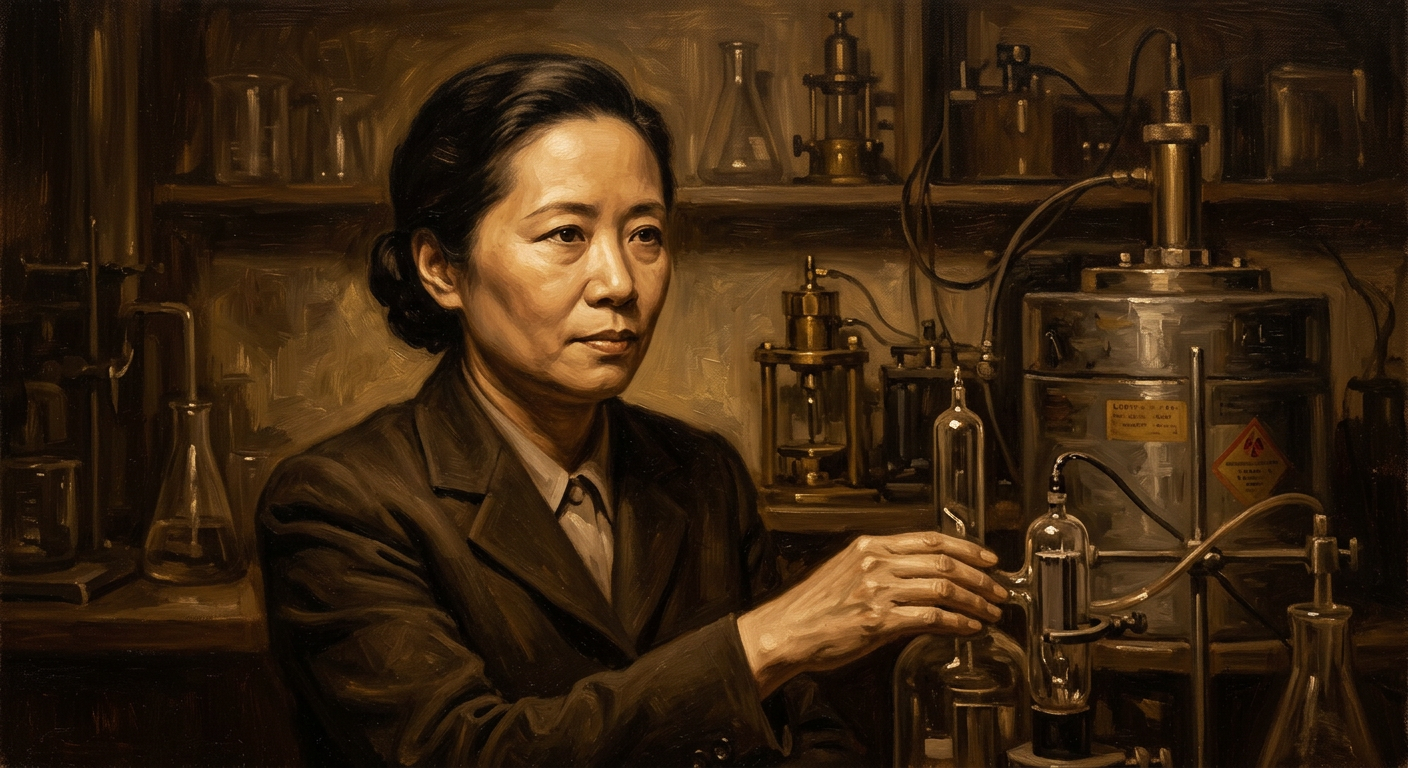
Chien-Shiung Wu
1912–1997 · Experimental Physicist
Chien-Shiung Wu was a brilliant experimental physicist whose work on the parity experiment overturned a basic law of physics. Known as the First Lady of Physics, she overcame prejudice as a woman and an immigrant to become one of the most respected scientists of the 20th century.
“I wonder whether the tiny atoms and nuclei, or the mathematical symbols, or the DNA molecules have any preference for either masculine or feminine treatment.”
Before her famous parity experiment, Wu secretly worked on the Manhattan Project, helping develop the gaseous-diffusion process to separate uranium-235 for the atomic bomb.
Why is this scientist famous?
Experimentally proving that parity is not conserved in weak nuclear interactions, overturning a fundamental assumption of physics.
Chien-Shiung's story
Early Life in China
Chien-Shiung Wu was born on May 31, 1912, in the small town of Liuhe in Jiangsu Province, China, near the mouth of the Yangtze River. Her father, Wu Zhong-Yi, was a remarkable man who founded a girls' school and passionately believed in educating daughters as well as sons. He gave his daughter a name that means 'courageous heroism,' and she grew up in a household where learning was treasured. Young Chien-Shiung excelled at mathematics and science, and her father's encouragement helped her pursue an education at a time when most Chinese girls had none. She went on to study physics at National Central University in Nanjing, where she graduated at the top of her class in 1934.
Journey to America
In 1936, Wu sailed to the United States to pursue graduate studies, leaving behind a homeland descending into war. She enrolled at the University of California, Berkeley, where she studied under Ernest Lawrence, the inventor of the cyclotron, and worked alongside some of the brightest physicists of the era. Berkeley was at the center of nuclear physics, and Wu thrived in the intense, competitive atmosphere. She earned her PhD in 1940 with a dissertation on the radioactive decay of uranium, a subject that would soon become enormously significant. As a woman and as a Chinese immigrant, she faced discrimination at every turn, but her experimental skill was so extraordinary that colleagues sought her out for the most difficult measurements.
The Parity Experiment
In 1956, Wu was approached by two theoretical physicists, Tsung-Dao Lee and Chen Ning Yang, who suspected that a long-held principle called parity conservation might be wrong. Parity was the idea that the laws of physics should look the same in a mirror, and nearly every physicist assumed it was an unbreakable rule. Lee and Yang could not test their theory themselves — they needed a world-class experimentalist. Wu designed and led an extraordinarily precise experiment at the National Bureau of Standards in Washington, D.C., using radioactive cobalt-60 atoms cooled to near absolute zero. Her results, published in 1957, were unambiguous: nature did distinguish left from right. The discovery shocked the physics world and led to Lee and Yang winning the Nobel Prize that same year. Wu was not included in the award, a decision many scientists considered deeply unfair.
Legacy
Although she was overlooked for the Nobel Prize, Wu received nearly every other honor in physics, including the National Medal of Science, the Wolf Prize, and the first woman to serve as president of the American Physical Society. She became a professor at Columbia University, where she was known as 'the Dragon Lady' for her exacting standards and fierce dedication to precision. She never stopped advocating for women in science and for the careful, honest experimental work she believed was the heart of physics. She died on February 16, 1997, in New York City, having changed our understanding of the universe and opened doors for generations of scientists who followed.
What did they discover?
Parity Violation in Weak Interactions
Wu's cobalt-60 experiment proved that weak nuclear interactions do not conserve parity, meaning nature distinguishes left from right. The result overturned a cherished assumption and reshaped particle physics.
Manhattan Project Uranium Separation
During World War II, Wu developed the gaseous-diffusion process for separating fissile uranium-235 from uranium-238, contributing directly to the atomic bomb program at Columbia's SAM Laboratories.
Beta Decay Research
Wu became the world's leading expert on beta decay, the process by which a neutron transforms into a proton, electron, and antineutrino. Her precise measurements helped confirm the theory of weak interactions.
Amazing facts
Her father named her Chien-Shiung, meaning 'courageous heroism,' and she lived up to the name throughout her life.
She was the first woman to receive an honorary doctorate from Princeton University.
Her parity experiment was so important that Lee and Yang won the Nobel Prize within months of her results, but she was not included in the award.
She was nicknamed 'the Dragon Lady' by her students for her fierce dedication to experimental precision.
She was the first woman to serve as president of the American Physical Society.
She received the Wolf Prize in Physics in 1978, one of the most prestigious awards in the field after the Nobel.
Timeline
Born in Liuhe, Jiangsu Province, China
Graduated at the top of her class in physics from National Central University, Nanjing
Sailed to the United States to begin graduate studies at UC Berkeley
Earned her PhD in physics from UC Berkeley with a dissertation on uranium decay
Joined the Manhattan Project at Columbia University's SAM Laboratories
Designed and led the parity violation experiment at the National Bureau of Standards
Her parity experiment results were published, overturning a fundamental law of physics
Became the first woman president of the American Physical Society
Received the Wolf Prize in Physics for her contributions to nuclear physics
Died in New York City on February 16, age 84
Awards & honours
Related Super Scientists
Marie Curie
1867–1934 · Physicist & Chemist
Discovering radioactivity and two new elements: radium and polonium.
Lise Meitner
1878–1968 · Physicist
Co-discovered nuclear fission and explained how splitting atoms releases enormous energy.
Niels Bohr
1885–1962 · Physicist
Developed the Bohr model of the atom and made foundational contributions to quantum mechanics.
Sources & references
Books and educational kits about Chien-Shiung Wu coming soon