_(2).jpg)
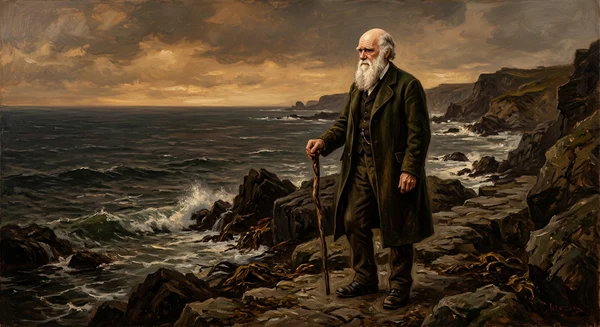
Charles Darwin
1809–1882 · Naturalist & Biologist
Charles Darwin transformed our understanding of life on Earth by showing that species evolve over generations through natural selection.
“It is not the strongest of the species that survives, nor the most intelligent, but the one most responsive to change.”
Darwin spent over 20 years gathering evidence before publishing his theory of evolution — he was terrified of the controversy it would cause.
Why is this scientist famous?
Proposing the theory of evolution by natural selection.
Darwin's theory of evolution by natural selection explains how life adapts — including how bacteria evolve to resist antibiotics and how viruses change over time. Understanding evolution helps doctors fight diseases and conservationists protect endangered species. Every time you hear about a new virus variant, you are seeing evolution in action.
Charles's story
Early Life
Born in Shrewsbury, England, into a wealthy, educated family. Young Charles was an unremarkable student, more interested in beetles and shooting than in medicine or theology, to his father's despair. He enrolled at Edinburgh to study medicine but was horrified by surgery before anaesthesia, and switched to Cambridge for divinity, where his passion for natural history flourished under the mentorship of botanist John Stevens Henslow.
The Beagle Voyage
In 1831, Darwin joined HMS Beagle as the ship's naturalist on a five-year surveying expedition around the world. The voyage was transformative: the wildlife of the Galápagos Islands — particularly finches with differently shaped beaks on each island — planted the seeds of his great idea. He also found giant fossil mammals in South America and experienced an earthquake in Chile that raised the land by several feet, showing him that the Earth itself is dynamic.
Twenty Years of Doubt
Back in England, Darwin spent over twenty years gathering evidence, breeding pigeons, studying barnacles, and conducting experiments on plant reproduction. He was afraid to publish such a radical idea, knowing it would challenge religious doctrine and outrage Victorian society. He developed stomach ailments, possibly stress-related, that troubled him for the rest of his life. When a young naturalist named Alfred Russel Wallace independently arrived at the same theory in 1858, Darwin was spurred to act. Their ideas were jointly presented at the Linnean Society, and Darwin rushed to publish 'On the Origin of Species' in 1859. The book sold out on its first day.
The Storm that Followed
The Origin of Species provoked an immediate firestorm. The famous 1860 Oxford debate pitted Darwin's supporter Thomas Huxley against Bishop Samuel Wilberforce, who asked Huxley whether he was descended from an ape on his grandfather's or grandmother's side. Huxley replied that he would rather be descended from an ape than from a man who used his great gifts to obscure the truth. Darwin himself avoided such public confrontations, preferring to let his evidence speak.
Later Works
Darwin continued researching and publishing prolifically. In 1871 he published 'The Descent of Man,' explicitly applying evolution to human beings. He wrote groundbreaking books on orchids, insectivorous plants, climbing plants, the expression of emotions in humans and animals, and the action of earthworms in forming soil. His experimental approach to these subjects was as innovative as his evolutionary theory.
Legacy
Darwin's theory of evolution by natural selection became the unifying principle of all biology, connecting genetics, palaeontology, ecology, and medicine. He died in 1882 and, by parliamentary petition, was buried in Westminster Abbey near Isaac Newton — an honour his modest, reclusive nature would never have sought. His home, Down House in Kent, is now a UNESCO World Heritage Site where his garden experiments have been recreated.
What did they discover?
Evolution by Natural Selection
Proposed that organisms with traits suited to their environment survive and reproduce, passing those traits to offspring. Over vast time, this produces new species — the central mechanism of evolution.
Common Descent
Showed that all living things share common ancestors, meaning every species on Earth is related — a profoundly unifying insight that connected all of biology.
Galápagos Observations
His study of Galápagos finches and tortoises provided key evidence that species change to fit their environment, with different islands producing different adaptations.
Sexual Selection
Identified a second mechanism of evolution in which mate choice drives the development of traits like peacock tails, even when they seem to reduce survival.
Earthworms and Soil Formation
His final book showed that earthworms are major geological agents, gradually transforming soil and burying ancient structures over centuries.
Amazing facts
He and Abraham Lincoln were born on the exact same day: 12 February 1809.
He ate every animal he discovered, including owls, iguanas, and pumas — part of the 'Glutton Club' at Cambridge.
He delayed publishing 'On the Origin of Species' for over 20 years, partly out of fear of public reaction.
He married his first cousin Emma Wedgwood and had ten children.
His journey on HMS Beagle lasted nearly five years, from 1831 to 1836.
He is buried in Westminster Abbey near Isaac Newton.
He suffered from chronic stomach illness for most of his adult life, possibly from a parasite picked up in South America.
He kept pigeons in his garden to study how breeds change over generations — a living analogy for natural selection.
His only diagram in 'On the Origin of Species' was a tree of life — the first visual representation of how species branch from common ancestors.
He lost his religious faith gradually, partly because of the death of his beloved daughter Annie at age 10.
Timeline
Born in Shrewsbury, England
Went to Edinburgh to study medicine, but was horrified by surgery
Transferred to Cambridge to study divinity
Joined HMS Beagle on a five-year voyage
Visited the Galápagos Islands, collecting the finches that would become key evidence
Returned to England with extensive specimens and notes
Moved to Down House in Kent, where he worked for the rest of his life
Jointly presented ideas with Alfred Russel Wallace at the Linnean Society
Published 'On the Origin of Species', which sold out on the first day
The famous Oxford debate between Huxley and Wilberforce
Published 'The Descent of Man', applying evolution to humans
Published his final book on earthworms and soil formation
Died and was buried in Westminster Abbey near Newton
Awards & honours
Related Super Scientists
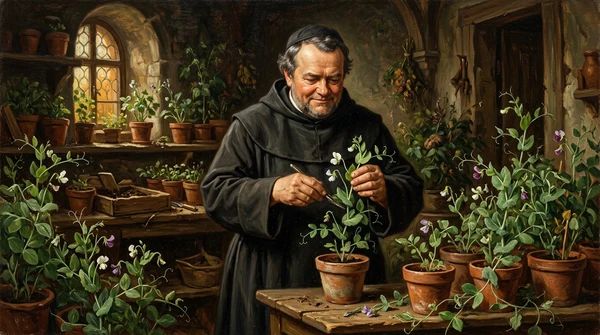
Gregor Mendel
1822–1884 · Biologist & Augustinian Friar
Discovered the fundamental laws of genetic inheritance by studying pea plants.
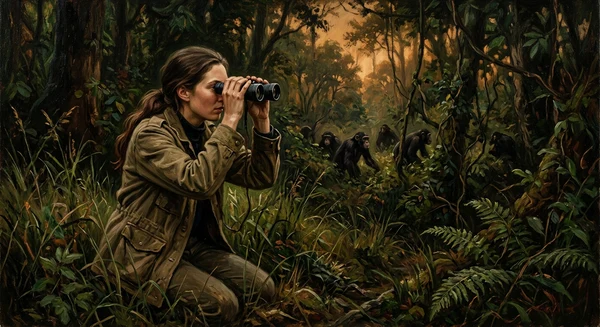
Jane Goodall
1934–present · Primatologist & Anthropologist
Spending 60 years studying wild chimpanzees and redefining what it means to be human.
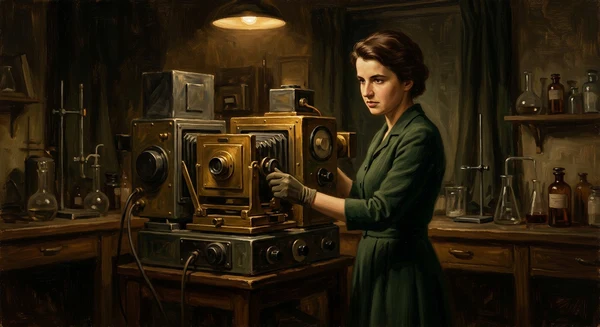
Rosalind Franklin
1920–1958 · Chemist & X-ray Crystallographer
Taking the photograph that revealed the double-helix structure of DNA.
Sources & references
Books and educational kits about Charles Darwin coming soon