_(2).jpg)
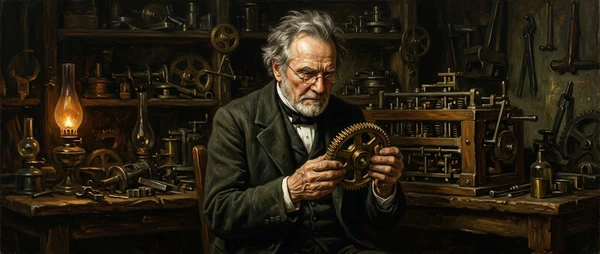
Charles Babbage
1791–1871 · Mathematician & Inventor
Charles Babbage was a mathematician and inventor who designed the first automatic calculating machines. Though his machines were never fully built in his lifetime, they contained every key idea behind modern computers.
“On two occasions I have been asked, "Pray, Mr. Babbage, if you put into the machine wrong figures, will the right answers come out?" I am not able rightly to apprehend the kind of confusion of ideas that could provoke such a question.”
Babbage designed a computer in the 1830s that was so advanced it couldn't be built with the technology of his time — it took over 150 years before anyone could construct one.
Why is this scientist famous?
Designed the first mechanical computer — the Difference Engine and the Analytical Engine.
Babbage designed the Analytical Engine, a mechanical computer that could store data and run instructions — the same basic architecture as every modern computer. Although it was never fully built in his lifetime, his idea became the blueprint for the device you are reading this on right now.
Charles's story
Early Life
Born in London in 1791, Babbage showed an early talent for mathematics. He attended Cambridge University, where he helped found the Analytical Society to modernize British mathematics, which had fallen behind continental Europe.
The Difference Engine
While checking astronomical tables by hand, Babbage was appalled by the number of errors. He conceived the Difference Engine — a machine that could calculate and print tables automatically without human error. The British government funded the project, but it grew increasingly complex and was never completed.
The Analytical Engine
Babbage's boldest idea was the Analytical Engine, designed in the 1830s. It had a separate processor (the "mill"), memory (the "store"), and could be programmed with punched cards — the exact architecture of a modern computer. It could loop, branch, and make decisions. It was never built in his lifetime because the precision engineering required didn't yet exist.
Legacy
Babbage died in 1871 with his machines unfinished. His designs were rediscovered in the 20th century and proved to be conceptually complete computers. In 1991, the Science Museum in London built a Difference Engine to his original designs — and it worked perfectly.
What did they discover?
Difference Engine
A mechanical calculator designed to automatically compute polynomial functions and eliminate human error in mathematical tables.
Analytical Engine
The first design for a general-purpose computer, with a separate CPU, memory, and programmable input via punched cards — over a century before electronic computers existed.
Amazing facts
He was known as the "irascible genius" for his combative personality and feuds with street musicians.
He invented the cow-catcher — the triangular device on the front of American trains to push obstacles off the track.
He hated street musicians and once complained they cost him a quarter of his working time.
Ada Lovelace was his friend and collaborator — she wrote the first program for his Analytical Engine.
The Science Museum in London built his Difference Engine No. 2 in 1991, 153 years after he designed it, and it worked flawlessly.
He held the Lucasian Chair of Mathematics at Cambridge — the same chair later held by Stephen Hawking.
Timeline
Born in London, England on December 26
Entered Trinity College, Cambridge
Co-founded the Analytical Society to reform British mathematics
Proposed the Difference Engine to the British government
A partial Difference Engine was demonstrated — the only part ever built in his lifetime
Designed the Analytical Engine, the first concept for a general-purpose computer
Ada Lovelace published her notes on the Analytical Engine, including the first computer program
Died in London on October 18, age 79
Awards & honours
Related Super Scientists
Ada Lovelace
1815–1852 · Mathematician
Writing the first computer algorithm, a century before electronic computers existed.
Alan Turing
1912–1954 · Mathematician & Computer Scientist
Breaking Nazi codes and founding the science of artificial intelligence.
Grace Hopper
1906–1992 · Computer Scientist & Naval Admiral
Inventing the first compiler and making programming accessible with English-like languages.
Sources & references
Books and educational kits about Charles Babbage coming soon