_(2).jpg)
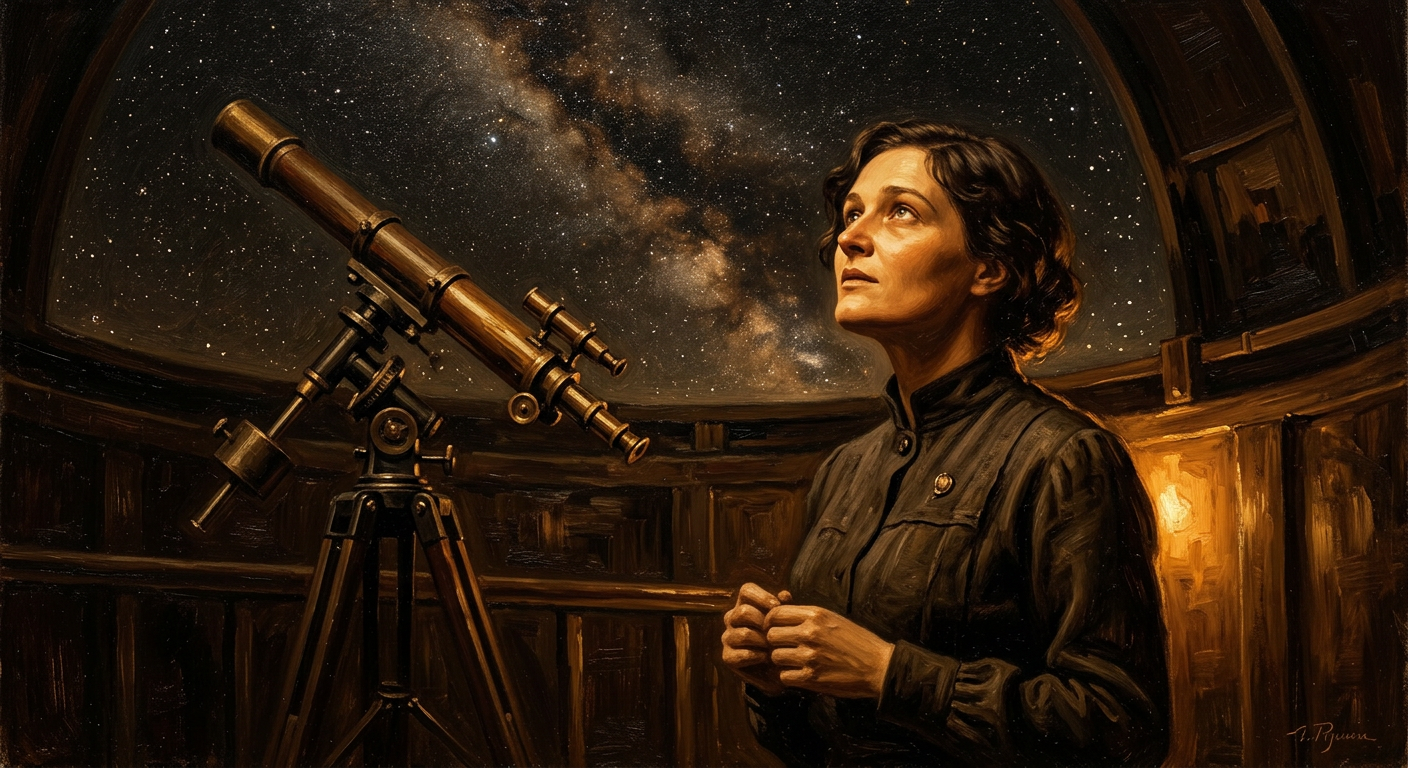
Cecilia Payne-Gaposchkin
1900–1979 · Astronomer
A British-American astronomer at Harvard who discovered the true chemical composition of the stars, only to be told she was wrong by the man who later took credit for her insight.
“The reward of the young scientist is the emotional thrill of being the first person in the history of the world to see something or to understand something.”
Her supervisor Henry Norris Russell told her that her conclusion about hydrogen was clearly wrong — then published the same finding himself four years later.
Why is this scientist famous?
Showed in her 1925 doctoral thesis that stars are composed mainly of hydrogen and helium — a discovery so radical that even her own supervisor initially refused to believe it.
Cecilia's story
A Curious Mind in England
Cecilia Helena Payne was born on 10 May 1900 in Wendover, Buckinghamshire, England. Her father, a barrister and musician, died when she was four, leaving her mother to raise three children alone. Cecilia was a precocious, fiercely intelligent child who taught herself Latin and Greek, studied botany and astronomy, and read every science book she could find. She won a scholarship to Newnham College, Cambridge, in 1919, where she initially studied botany before switching to physics and astronomy after attending a lecture by Arthur Eddington about his expedition to observe a solar eclipse and test Einstein’s theory of general relativity. The lecture changed her life. But Cambridge in the 1920s did not grant degrees to women, and the scientific establishment offered few opportunities for a female astronomer.
Cambridge and the Ceiling for Women
At Cambridge, Payne studied under Eddington and learned the new science of stellar spectroscopy — analysing the light from stars to determine their chemical composition. She was brilliant, but the path ahead was blocked. Cambridge would not give her a degree, and British observatories did not hire women for research positions. Then she heard about Harlow Shapley, the director of the Harvard College Observatory in America, who had begun hiring women to analyse the observatory’s vast collection of photographic plates of stellar spectra. In 1923, she travelled to the United States on a fellowship to work at Harvard, joining the group of women known as the Harvard Computers.
Harvard College Observatory
The Harvard College Observatory was one of the most important astronomical institutions in the world, with a collection of hundreds of thousands of glass photographic plates capturing the light of stars. The women who analysed these plates were paid less than clerical workers and were officially classified as ‘assistants’, but they produced some of the most important astronomical research of the 20th century. Payne threw herself into the work, applying the thermal ionisation equations of the Indian physicist Meghnad Saha to the stellar spectra she was studying. By comparing the strength of different absorption lines in stellar spectra, she could estimate the temperatures and chemical abundances of stars. What she found astonished her — and would astonish the world.
The Thesis That Changed Astronomy
In 1925, Payne completed her doctoral thesis, titled ‘Stellar Atmospheres’. It was, in the words of the astronomer Otto Struve, ‘the most brilliant thesis ever written in astronomy’. Her conclusion was revolutionary: the stars, including our Sun, were composed overwhelmingly of hydrogen and helium — the two lightest elements — with all other elements present only in trace amounts. This contradicted the prevailing view, championed by Henry Norris Russell at Princeton, that stars had roughly the same chemical composition as the Earth. Russell, the most powerful astronomer in America, reviewed Payne’s thesis and told her that her conclusion about hydrogen was ‘clearly impossible’. Under pressure, Payne added a sentence to her thesis calling her own result ‘almost certainly not real’. It was a concession she would regret for the rest of her life.
Years of Unrecognised Work
Four years later, in 1929, Russell published a paper reaching the same conclusion — that stars were composed mainly of hydrogen — using different methods. He mentioned Payne’s work briefly but presented the finding as his own, and the scientific community credited him with the discovery. Payne, meanwhile, continued at Harvard but was denied a proper academic position for decades. She was technically a ‘technical assistant’, not an astronomer, despite her doctorate and her publications. She married the Russian astronomer Sergei Gaposchkin in 1934, and together they had three children and continued their research. She published dozens of papers on variable stars and the structure of the Milky Way, but her salary remained low and her title unchanged. It was not until 1938 that Harvard granted her the title of astronomer.
Chair and Legacy
In 1956, Payne-Gaposchkin finally received the recognition she deserved. Harvard appointed her to a full professorship — making her the first woman to be promoted to professor within the Faculty of Arts and Sciences. Later that same year, she became the first woman to chair a department at Harvard, taking over the Astronomy Department. She received the Henry Norris Russell Prize from the American Astronomical Society in 1976 — the same man who had once dismissed her work now gave his name to the prize she received. She died on 7 December 1979 in Cambridge, Massachusetts, at the age of 79. Her thesis is now recognised as one of the most important works in the history of astronomy, and her discovery that hydrogen is the most abundant element in the universe laid the foundation for modern astrophysics and cosmology.
What did they discover?
Stellar Chemical Composition (1925)
In her doctoral thesis, Payne-Gaposchkin showed that stars are composed mainly of hydrogen and helium, with heavier elements present only in trace amounts. This overturned the assumption that stars had the same composition as the Earth and laid the foundation for modern astrophysics.
Stellar Temperature Measurement
She applied Meghnad Saha’s ionisation equations to stellar spectra, developing a method to determine the temperatures and chemical abundances of stars from their spectral lines — a technique still used today.
Variable Star Cataloguing
Over her career at Harvard, she and her team catalogued over three million variable stars — stars whose brightness changes over time — creating a dataset that remains essential to modern astronomy.
Amazing facts
Her 1925 doctoral thesis was described by astronomer Otto Struve as ‘the most brilliant thesis ever written in astronomy’.
She was the first person to earn a PhD in astronomy from Radcliffe College, Harvard’s coordinate college for women.
Henry Norris Russell told her that her conclusion about hydrogen was ‘impossible’ — then published the same finding himself four years later.
Despite her doctorate, she was officially classified as a ‘technical assistant’ at Harvard for decades, not an astronomer.
She became the first woman to chair a department at Harvard University in 1956, heading the Astronomy Department.
She used equations developed by the Indian physicist Meghnad Saha to analyse stellar spectra, combining physics and astronomy in a way no one had done before.
She and her husband Sergei Gaposchkin, also an astronomer, had three children and worked together at Harvard for decades.
She received the Henry Norris Russell Prize in 1976 — named after the man who had once dismissed her work.
A crater on the Moon and an asteroid are named in her honour.
She added a sentence to her own thesis calling her hydrogen finding ‘almost certainly not real’, a concession she regretted for the rest of her life.
Timeline
Born in Wendover, Buckinghamshire, England
Won a scholarship to Newnham College, Cambridge
Moved to the United States to work at Harvard College Observatory
Completed her doctoral thesis ‘Stellar Atmospheres’ at Radcliffe College
Became the first person to earn a PhD in astronomy from Radcliffe College
Henry Norris Russell published the same conclusion about stellar hydrogen, receiving much of the credit
Married the Russian astronomer Sergei Gaposchkin
Harvard finally granted her the title of astronomer
Became the first woman to chair a department at Harvard University
Received the Henry Norris Russell Prize from the American Astronomical Society
Died in Cambridge, Massachusetts, aged 79
Awards & honours
Related Super Scientists
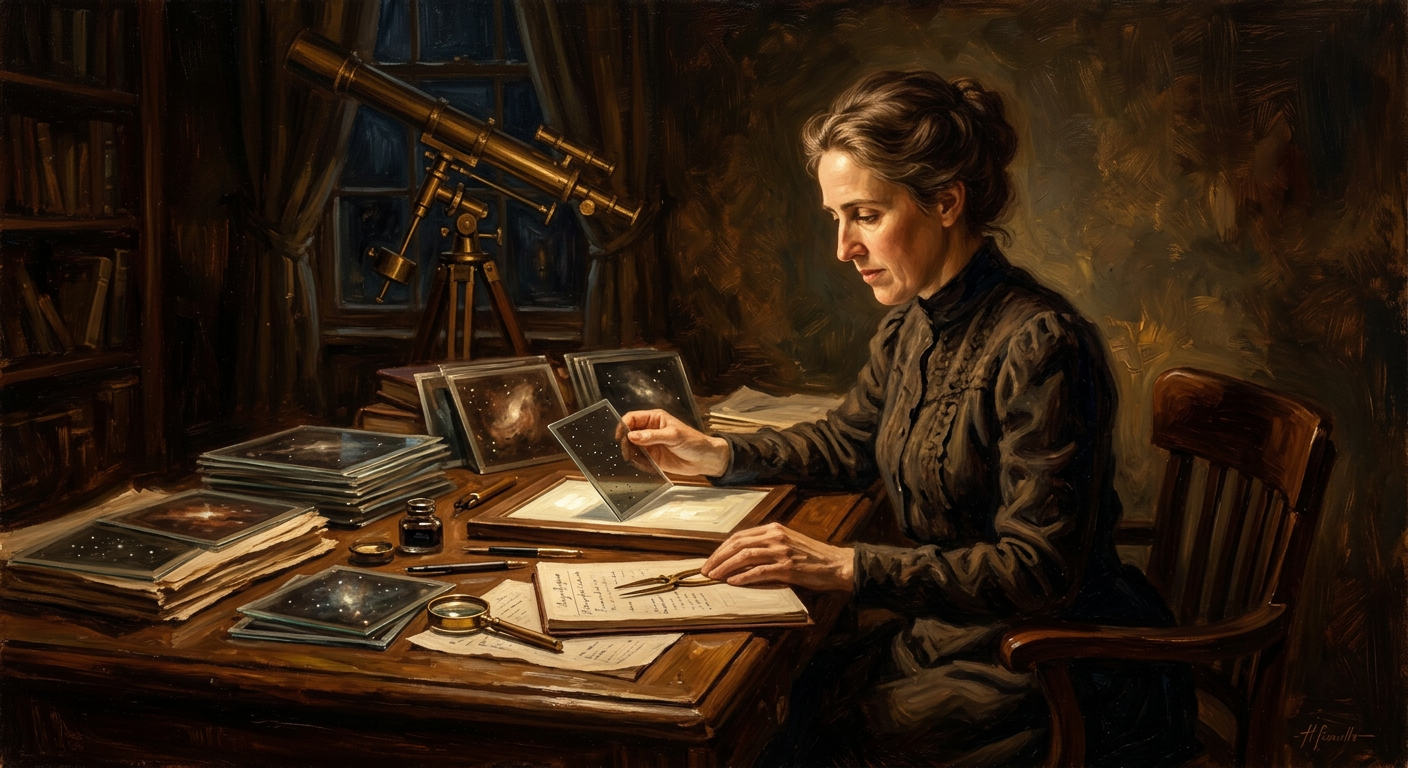
Henrietta Leavitt
1868–1921 · Astronomer
Discovering the period-luminosity relationship of Cepheid variable stars, which gave astronomy its first reliable method for measuring cosmic distances.
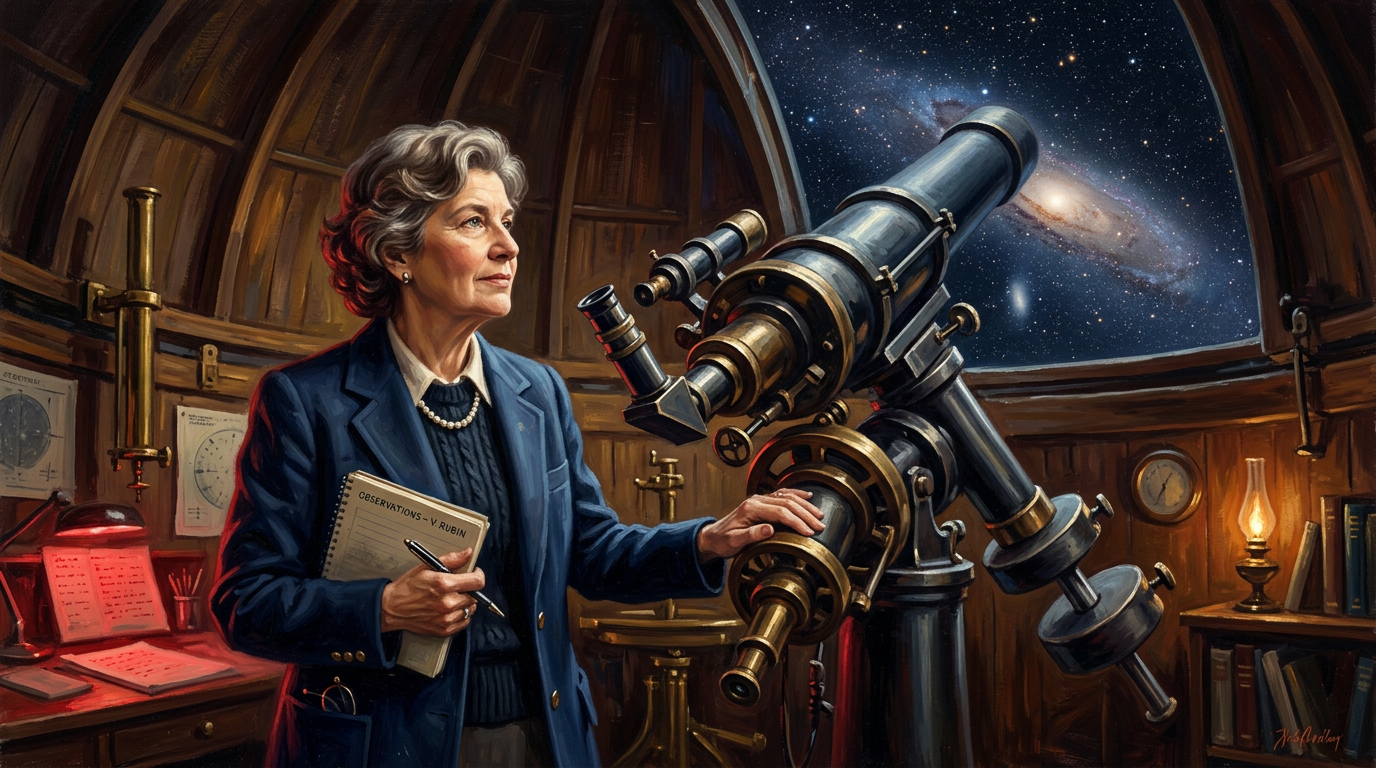
Vera Rubin
1928–2016 · Astronomer
Providing the most compelling early evidence for the existence of dark matter through galaxy rotation measurements.
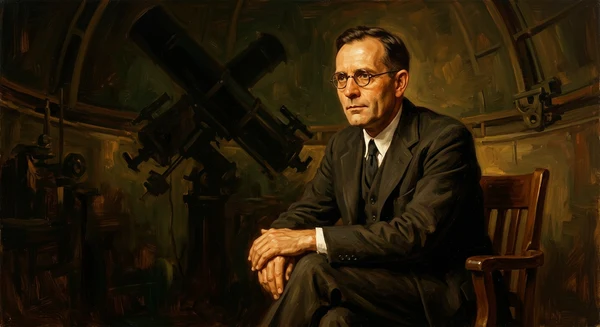
Edwin Hubble
1889–1953 · Astronomer
Proved that the universe is expanding and that other galaxies exist beyond our own.
Sources & references
Books and educational kits about Cecilia Payne-Gaposchkin coming soon