_(2).jpg)
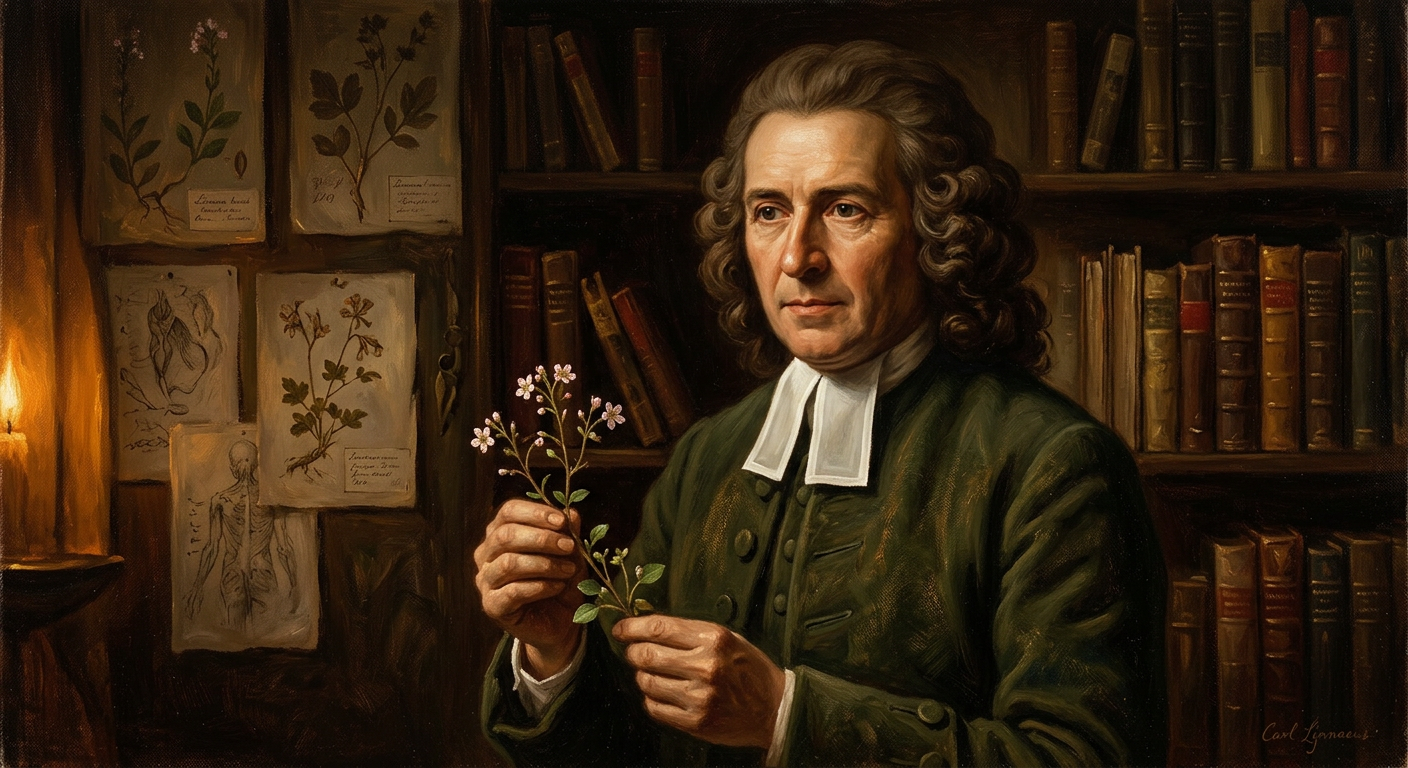
Carl Linnaeus
1707–1778 · Botanist and Zoologist
A Swedish naturalist who gave every living thing a two-part Latin name — like Homo sapiens — and brought order to the natural world.
“If you do not know the names of things, the knowledge of them is of no use to you.”
Linnaeus classified humans as animals, placing them in the same group as monkeys and sloths — a controversial decision that offended some of his contemporaries.
Why is this scientist famous?
Created the system for naming and classifying all living things that scientists still use today.
Carl's story
A Boy Obsessed with Plants
Carl Linnaeus was born in 1707 in the village of Råshult in southern Sweden. His father, Nils, was the village pastor and a keen gardener who had created a large and beautiful garden around their parsonage. Carl grew up among flowers and was so fixated on plants that his schoolmates nicknamed him “the little botanist”. His father hoped he would become a clergyman, but Carl showed no interest in theology and struggled at school — he was restless, talkative, and preferred exploring fields to studying Latin. A local doctor noticed the boy’s passion for plants and persuaded his parents to let him study medicine instead of theology, since botany was an essential part of medical training in those days. At twenty, Linnaeus went to the University of Lund to study medicine, but he spent more time in the botanical garden than in the lecture hall. A year later he transferred to Uppsala, the most prestigious university in Sweden, where he would spend the most formative years of his life.
The Lapland Journey
In 1732, at the age of twenty-five, Linnaeus received a grant from the Royal Society of Sciences in Uppsala to travel to Lapland — the wild, remote northern region of Sweden above the Arctic Circle. He travelled alone on foot and by horse for over five months, covering nearly 2,000 kilometres through forests, mountains, and marshes. He collected and described hundreds of plants, animals, and minerals he had never seen before, and he observed the lives of the Sami people with deep respect. He wore Sami clothing and learned their techniques for surviving in the harsh Arctic environment. The journey was formative in two ways: it gave him an enormous collection of specimens to classify, and it convinced him that the natural world was far richer and more varied than anyone had realised. He returned with a vision: to create a single, rational system that could bring order to all of it.
Naming the Living World
Linnaeus’s great idea was simple but revolutionary. Every living thing, he proposed, should have a two-part name in Latin: first the genus (a broad group), then the species (a specific type within that group). Humans became Homo sapiens — “wise human”. The dog became Canis familiaris. The oak tree became Quercus robur. This binomial system, as it is called, meant that for the first time scientists across the world could refer to exactly the same species without confusion. He also grouped species into broader categories — class, order, genus, species — creating a hierarchy that made the diversity of life navigable. He published this system in 1735 in a slim book called Systema Naturae, which he expanded and revised through twelve editions over his lifetime. He classified thousands of plants and animals, including humans, whom he boldly placed among the primates — alongside monkeys — a decision that was controversial then and remains powerful today. His system was so clear and practical that it was adopted almost universally within a generation, and it is still the system used by biologists today.
The Prince of Botanists
Linnaeus became one of the most famous scientists in Europe. He returned to Uppsala as a professor in 1741 and transformed its botanical garden into one of the finest in the world. Students flocked from across Europe to study with him — his pupils included some of the greatest explorers and naturalists of the next generation, and they sent him specimens from every continent. He was given the title of Royal Botanist by the King of Sweden and was ennobled in 1761, taking the noble name Carl von Linné. He was a charismatic and popular teacher, famous for his lively lectures and his habit of leading botanical walks through the countryside. But his health declined in his later years, and he suffered strokes that affected his memory. He died in 1778, aged seventy, and was buried in Uppsala Cathedral — a rare honour for a scientist. His collection of specimens and books was sold to a British buyer after his death and now resides in London, at the Linnean Society. Every time a child learns that humans are Homo sapiens, or that a dog is Canis familiaris, they are using the system Carl Linnaeus invented in a Swedish garden almost three centuries ago.
What did they discover?
Binomial Nomenclature
Linnaeus created the two-part naming system used for all species — genus plus species, like Homo sapiens. It allows scientists worldwide to refer to any living thing precisely and unambiguously.
Systema Naturae
His 1735 book established a hierarchical classification system — kingdom, class, order, genus, species — that made the diversity of life navigable and is still the foundation of biological taxonomy.
Classification of Humans as Animals
Linnaeus placed humans in the animal kingdom, within the primate order alongside monkeys and sloths — a radical decision that challenged the view that humans were entirely separate from the rest of nature.
Standardisation of Botanical Science
Through his teaching at Uppsala and his students’ expeditions, Linnaeus established a global network of specimen collection that transformed botany into a systematic, worldwide science.
Amazing facts
Linnaeus’s schoolmates called him “the little botanist” because he was so obsessed with plants.
He travelled nearly 2,000 kilometres through Lapland alone on foot and by horse, collecting hundreds of new species.
He was ennobled by the King of Sweden in 1761 and took the noble name Carl von Linné.
His personal collection of over 14,000 specimens was sold to a British buyer after his death and is now held by the Linnean Society in London.
He taught some of the greatest naturalists of the next generation, who sailed on voyages of exploration to every continent.
His book Systema Naturae went through twelve editions in his lifetime, each one bigger than the last.
Timeline
Born in Råshult, Småland, Sweden
Begins studying medicine at the University of Lund, then transfers to Uppsala
Travels alone to Lapland on a five-month expedition, collecting hundreds of new species
Publishes the first edition of Systema Naturae, introducing his classification system
Earns his medical degree at the University of Harderwijk in the Netherlands
Returns to Sweden and settles in Stockholm as a physician
Appointed professor of medicine and botany at Uppsala University
Publishes Species Plantarum, formally establishing the binomial naming system for plants
Ennobled by King Adolf Fredrik, taking the name Carl von Linné
Dies in Uppsala, aged 70, and is buried in Uppsala Cathedral
Awards & honours
Related Super Scientists
Charles Darwin
1809–1882 · Naturalist & Biologist
Proposing the theory of evolution by natural selection.
Gregor Mendel
1822–1884 · Biologist & Augustinian Friar
Discovered the fundamental laws of genetic inheritance by studying pea plants.
George Washington Carver
1864–1943 · Agricultural Scientist and Botanist
Transforming Southern agriculture by developing hundreds of products from peanuts and sweet potatoes, freeing farmers from dependence on cotton.
Sources & references
Books and educational kits about Carl Linnaeus coming soon