_(2).jpg)
Archimedes
-287–-212 · Mathematician and inventor
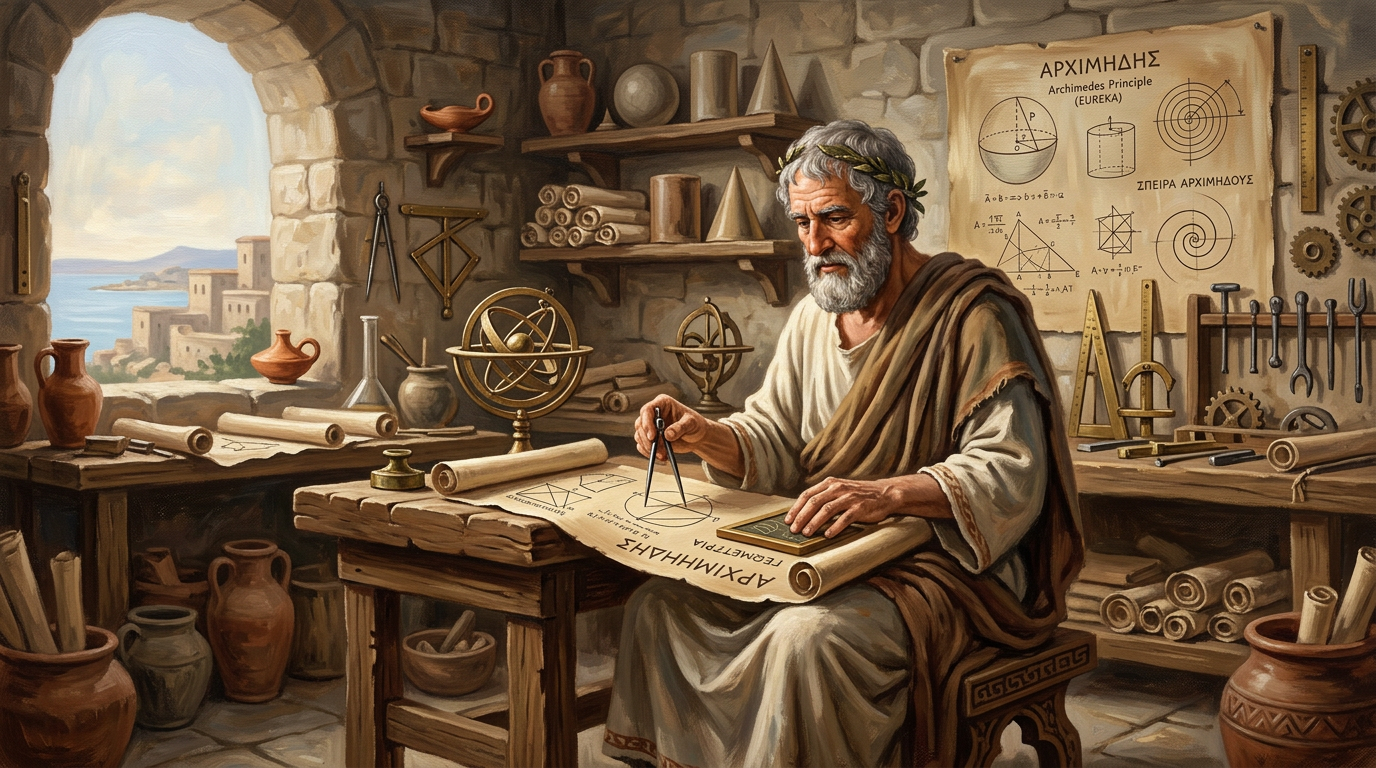
Archimedes of Syracuse was an ancient Greek mathematician, physicist, and engineer whose insights into geometry, mechanics, and hydrostatics were nearly two thousand years ahead of their time.
“Give me a place to stand, and I will move the Earth.”
Archimedes used a technique called the method of exhaustion to calculate areas and volumes — essentially inventing integral calculus nearly 2,000 years before Newton and Leibniz.
Why is this scientist famous?
Discovering the principles of buoyancy, the lever, and pioneering mathematical methods that anticipated calculus.
Archimedes figured out how levers and buoyancy work — the same physics that lets you lift something heavy with a seesaw or float in a swimming pool. His maths ideas were so far ahead of his time that they laid groundwork for calculus, the tool modern engineers use to design bridges, rockets, and roller coasters.
Archimedes's story
Early Life in Syracuse
Archimedes was born in the Greek city-state of Syracuse on the island of Sicily. Little is known about his personal life, but he is believed to have studied in Alexandria, the great centre of learning in Egypt, under followers of Euclid before returning to Syracuse where he spent most of his life working on mathematics and engineering under the patronage of King Hiero II. He maintained a correspondence with mathematicians in Alexandria throughout his life.
Mathematics Ahead of Its Time
Archimedes calculated the area of a circle by using the method of exhaustion — a technique that anticipates integral calculus by nearly two thousand years. He also worked out the surface area and volume of a sphere, showing that a sphere has two-thirds the volume of its circumscribing cylinder, which he considered his greatest achievement. He produced a remarkably accurate estimate of pi by bounding it between fractions, and his work on spirals, parabolas, and the area of geometric shapes was unsurpassed until the Renaissance.
Mechanics and Engineering
Archimedes discovered the principle of the lever, famously declaring, 'Give me a place to stand, and I will move the Earth.' He invented the Archimedes screw, a device for raising water that is still used today in developing countries. He designed compound pulley systems that allowed a single man to move a fully loaded ship, and he created an early odometer. His work on hydrostatics produced Archimedes' principle of buoyancy, reportedly discovered in his bath — he was so excited he ran through the streets of Syracuse naked shouting 'Eureka!'
The Siege of Syracuse
During the Roman siege of Syracuse in 214-212 BC, Archimedes designed war machines that held off the Roman fleet for two years. He built catapults calibrated to fire at different ranges, grappling cranes that could lift Roman ships out of the water, and reportedly used arrays of mirrors to set fire to enemy vessels — though the burning mirrors story is still debated. The Roman general Marcellus reportedly told his officers to spare Archimedes, but a soldier found the old man drawing geometric diagrams in the sand and killed him.
Legacy
Archimedes was killed in 212 BC during the capture of Syracuse. His tomb, which he requested be marked with a sphere and cylinder, was found by Cicero over a century later in an overgrown state. His writings survived through copies and translations, and rediscovery of his methods in the Renaissance deeply influenced Galileo, Kepler, and Newton. The Archimedes Palimpsest, a medieval manuscript containing lost works, was discovered in 1906 and revealed just how far ahead of his time he truly was — he had essentially invented calculus using mechanical arguments.
What did they discover?
Principle of Buoyancy
Archimedes' principle states that a body immersed in a fluid experiences an upward force equal to the weight of the fluid it displaces. He reportedly discovered this while bathing and was so excited he ran through the streets shouting 'Eureka!'
Law of the Lever
He proved that two weights balance at distances inversely proportional to their weights, establishing the mathematical foundation of mechanics and mechanical advantage.
Method of Exhaustion
A technique for finding the area and volume of shapes by inscribing and circumscribing polygons, which anticipated the ideas of integral calculus by nearly two millennia.
Approximation of Pi
He calculated that pi lies between 223/71 and 22/7, giving an accuracy unsurpassed for centuries, and used this to compute the area and circumference of a circle.
Amazing facts
He famously ran through the streets of Syracuse naked shouting 'Eureka!' after discovering the principle of buoyancy in his bath.
He designed war machines that held off a Roman fleet for two years during the siege of Syracuse.
His estimate of pi was so accurate it was not surpassed for nearly a thousand years.
A lost work by Archimedes, the Method, was discovered hidden underneath a medieval prayer book in 1906.
He invented the Archimedes screw, a device for raising water that is still used in developing countries today.
He was killed by a Roman soldier while drawing geometric diagrams in the sand, despite orders that he be spared.
He considered his proof that a sphere has two-thirds the volume of its circumscribing cylinder to be his greatest achievement.
He once used compound pulleys to drag a fully loaded ship single-handedly, to prove the power of the lever.
His tomb, marked with a sphere and cylinder, was found overgrown over a century later by the Roman orator Cicero.
The Archimedes Palimpsest revealed that he had essentially invented calculus 2,000 years before Newton and Leibniz.
Timeline
Born in Syracuse, Sicily
Studied in Alexandria under followers of Euclid
Developed the method of exhaustion and calculated the area of a circle
Wrote 'On Floating Bodies' and discovered the principle of buoyancy
Wrote 'On the Sphere and Cylinder,' his proudest achievement
Designed war machines to defend Syracuse against the Roman fleet
Built catapults, cranes, and possibly burning mirrors to repel Roman ships
Killed by a Roman soldier during the fall of Syracuse
Cicero found his overgrown tomb marked with a sphere and cylinder
The Archimedes Palimpsest revealed lost works hidden under a prayer book
Awards & honours
Related Super Scientists
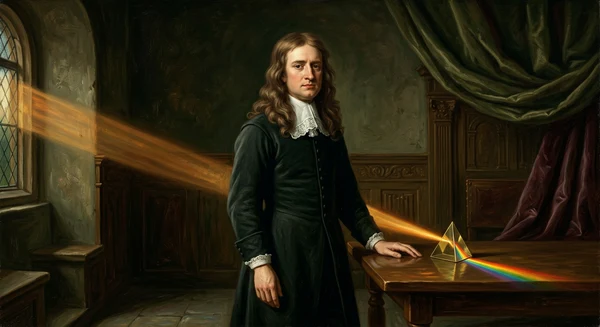
Isaac Newton
1643–1727 · Physicist & Mathematician
Formulating the laws of motion and universal gravitation.
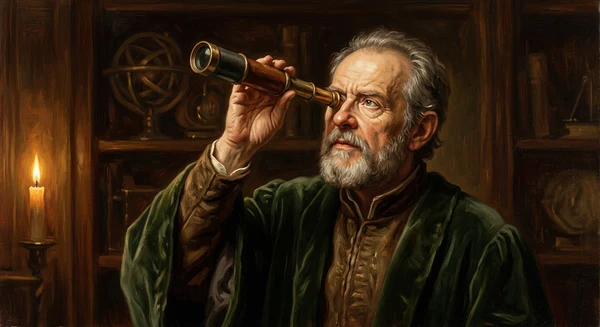
Galileo Galilei
1564–1642 · Astronomer & Physicist
Proving that the Earth orbits the Sun and founding modern observational astronomy.
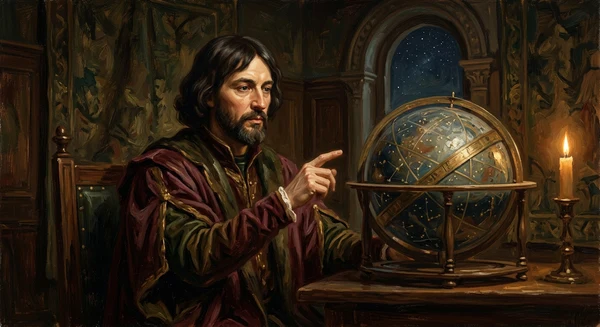
Nicolaus Copernicus
1473–1543 · Astronomer & Mathematician
Proposed the heliocentric model — that the Earth and planets revolve around the Sun.
Sources & references
Books and educational kits about Archimedes coming soon