_(2).jpg)
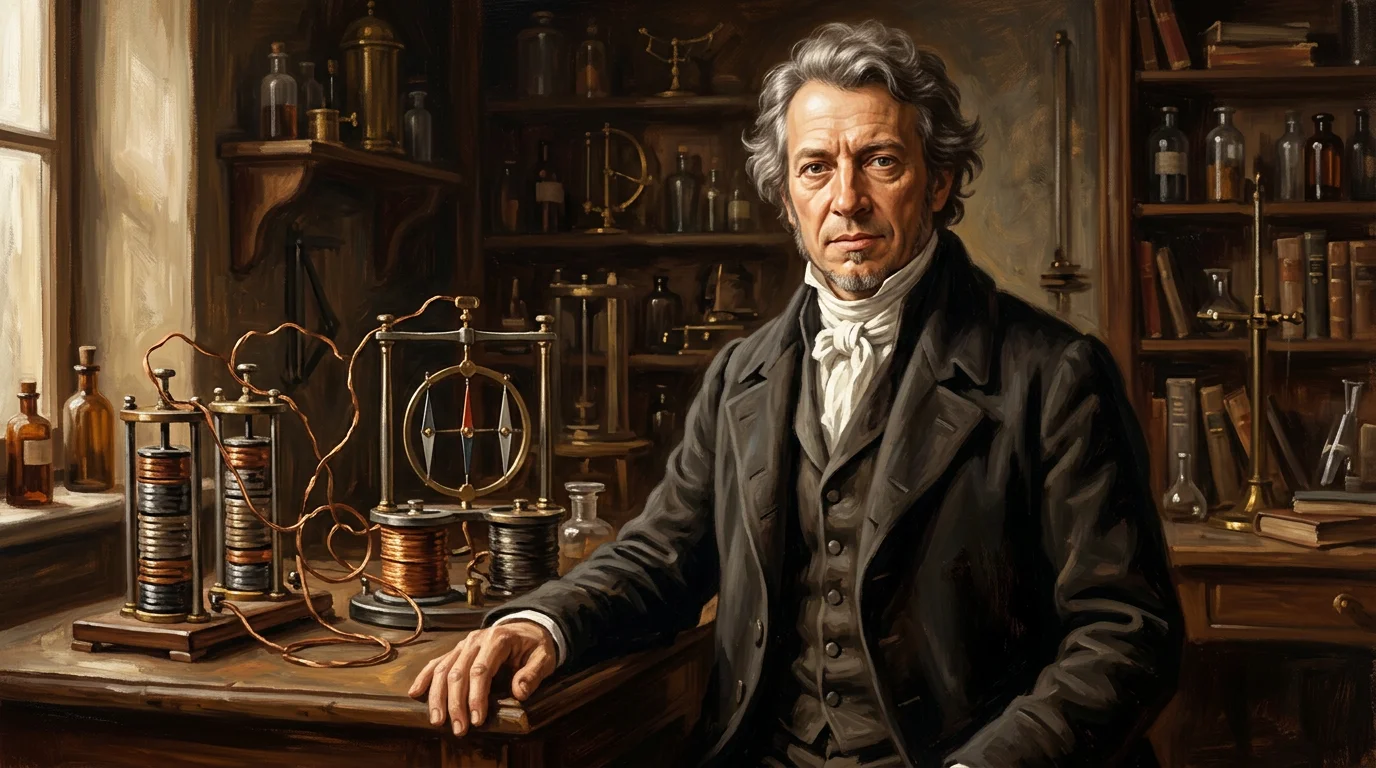
André-Marie Ampère
1775–1836 · Physicist and Mathematician
A French mathematician and physicist who, inspired by a chance discovery, founded the science of electrodynamics in a single astonishing week of work.
“The future destiny of science will be to show that all phenomena, however complex, are reducible to the simple laws of mechanics.”
Ampère invented the entire science of electrodynamics in one extraordinary week in October 1820, after witnessing a single demonstration of an electric current deflecting a compass needle.
Why is this scientist famous?
Foundational work on the relationship between electricity and magnetism. The SI unit of electric current, the ampere or amp (A), is named after him.
André-Marie's story
A Childhood Marked by Revolution
André-Marie Ampère was born near Lyon, France, during the reign of Louis XVI. His father was a prosperous merchant and local official who educated André-Marie at home using the Encyclopédie and the works of classical authors. The boy was a prodigy who taught himself advanced mathematics by the age of 12. But his life was shattered by the French Revolution. His father was arrested and executed on the guillotine in 1793 when André-Marie was 18. The trauma devastated him, and he spent a year in near-silence, wandering the countryside and recovering his mental health through the patient companionship of friends. He emerged from this period with a deep philosophical and religious sensibility that would stay with him for life.
Rise Through Mathematics
Ampère gradually rebuilt his life through science and mathematics. He became a schoolteacher in Bourg and then Lyon, and by 1804 he had moved to Paris, where he taught at the École Polytechnique. He was a polymath — contributing to mathematics, chemistry, and philosophy — but it was his appointment as professor of analysis at the École Polytechnique that established him in the scientific community. He was known among colleagues for his brilliant but disorganised mind: he could lecture brilliantly on any subject but frequently lost his notes, and his personal life was similarly chaotic. Despite personal difficulties, including the early death of his wife, he continued to produce original work across multiple fields.
The Week That Changed Physics
On 4 September 1820, Ampère attended a meeting of the French Academy of Sciences in Paris where François Arago reported on a startling discovery by the Danish physicist Hans Christian Ørsted: an electric current flowing through a wire could deflect a nearby compass needle. This was the first evidence that electricity and magnetism were connected. Ampère was electrified by the news. Within a week he had performed a series of experiments that laid the foundation for an entirely new science, which he named electrodynamics. He showed that two parallel wires carrying electric currents attract or repel each other depending on the direction of the currents. He derived the mathematical law governing this force. In seven days of intense work, he had transformed a curious observation into a rigorous new branch of physics.
Electrodynamics
Ampère continued to develop his new science over the following years. He published his magnum opus, 'Memoir on the Mathematical Theory of Electrodynamic Phenomena, Uniquely Deduced from Experience', in 1827. In it he presented the mathematical framework that describes the force between current-carrying wires — now known as Ampère's Law. He argued that magnetism itself was caused by circulating electric currents, a remarkably modern insight that anticipated the discovery of electrons by nearly a century. His work unified electricity and magnetism into a single framework and laid the groundwork that James Clerk Maxwell would later build upon to create the full theory of electromagnetism.
A Life of Contradictions
Despite his towering scientific achievements, Ampère's personal life was marked by tragedy and difficulty. His first wife died young. His daughter married a man Ampère despised, causing a painful family rupture. His son, Jean-Jacques, became a famous historian and writer but their relationship was strained. Ampère was deeply religious and philosophical, spending as much time on metaphysics and theology as on physics. He was known for his absent-mindedness — he once wrote a letter completely in blank because he had forgotten to dip his pen in ink. Yet behind the distracted exterior was one of the most powerful minds in European science.
Legacy
Ampère died in Marseille in 1836 at the age of 61. The SI unit of electric current — the ampere, abbreviated as A — was named in his honour in 1881. Every electrical appliance, every power line, every battery is rated in amperes. His insight that magnetism is caused by electric currents anticipated the atomic-scale understanding of magnetism that emerged a century later. The science he created in a single week in 1820 has grown into the entire field of electromagnetism, which underpins electric motors, generators, telecommunications, and every electronic device in existence.
What did they discover?
Ampère's Law
Derived the mathematical law describing the force between two parallel current-carrying wires. This was the first quantitative law of electromagnetism and laid the foundation for James Clerk Maxwell's later unified theory. The law is still used today in the design of electric motors, generators, and transformers.
Electrodynamics
Founded the entirely new science of electrodynamics in October 1820, showing that electric currents produce magnetic forces and that magnetism itself is caused by circulating electric currents — an insight that anticipated the discovery of the electron by nearly a century.
The Solenoid Concept
Ampère proposed that a helical coil of wire carrying a current would behave like a magnet, a device he helped conceptualise. This principle underlies the electromagnet, which is used in countless devices from doorbells to MRI machines.
The Ampere (SI Unit)
The ampere (A), the SI unit of electric current, was named in his honour in 1881. One ampere is the current that, flowing through two parallel wires one metre apart, produces a force of 2 × 10⁻⁷ newtons per metre of length — a definition directly based on Ampère's own experiments.
Amazing facts
Ampère invented the entire science of electrodynamics in a single extraordinary week in October 1820, after hearing about Ørsted's discovery of a current deflecting a compass needle.
His father was executed by guillotine during the French Revolution when André-Marie was 18, leaving him traumatised and silent for a year.
He was so absent-minded that he once wrote an entire letter in blank — he had forgotten to dip his pen in ink.
The ampere, the SI unit of electric current used to rate every electrical appliance on Earth, was named in his honour in 1881.
Ampère argued that magnetism was caused by circulating electric currents — a theory that anticipated the discovery of electrons by nearly a century.
He was a polymath who made contributions to mathematics, chemistry, philosophy, and theology, not just physics.
He coined the term 'electrodynamics' himself to describe the new science he had created.
Timeline
Born near Lyon, France
His father was executed by guillotine during the French Revolution; Ampère spent a year in shock
Moved to Paris and was appointed professor at the École Polytechnique
Witnessed a demonstration of Ørsted's discovery and founded electrodynamics in one week of intense work
Showed that two parallel wires carrying currents attract or repel each other
Published his magnum opus on the mathematical theory of electrodynamics
Appointed professor of physics at the Collège de France
Died in Marseille, aged 61
Awards & honours
Related Super Scientists
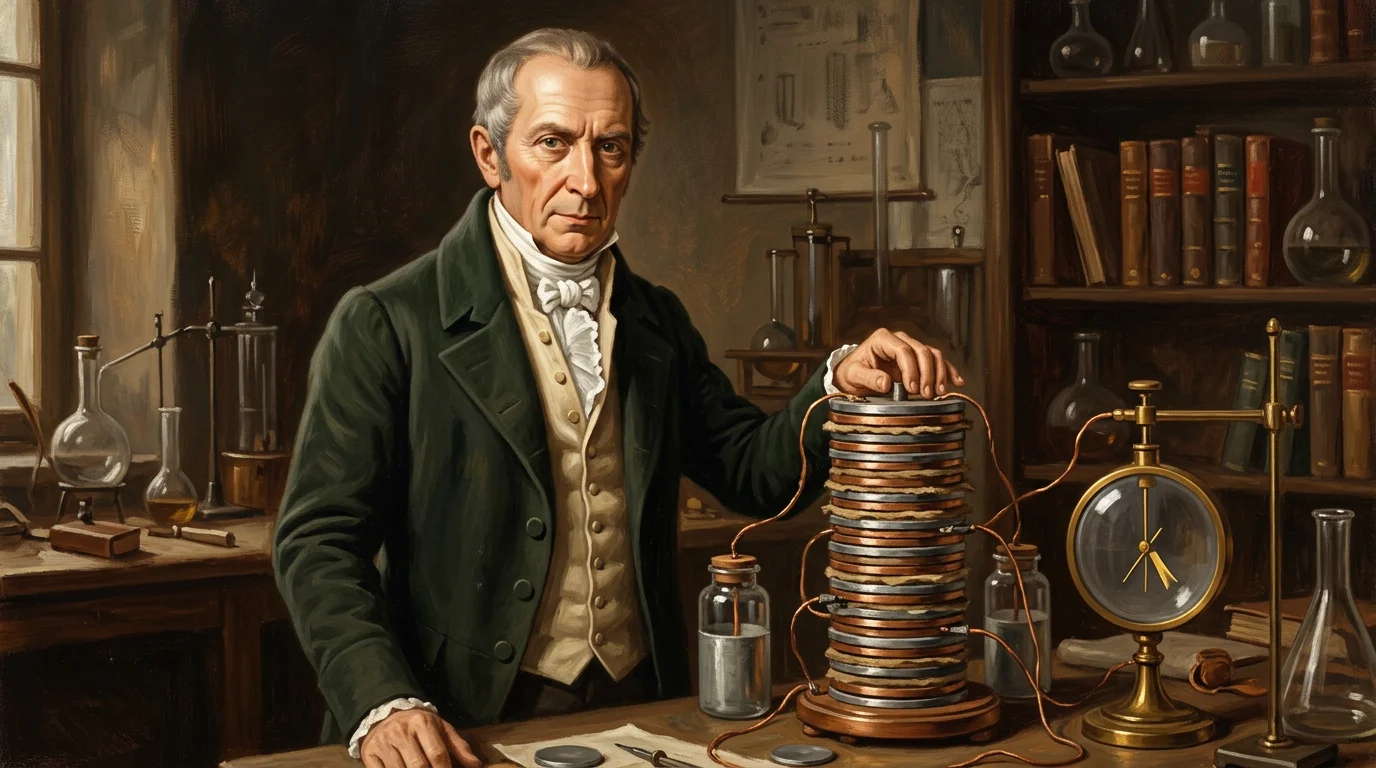
Alessandro Volta
1745–1827 · Physicist
Invented the voltaic pile in 1800, the first electric battery capable of producing a continuous current. The volt is named after him.
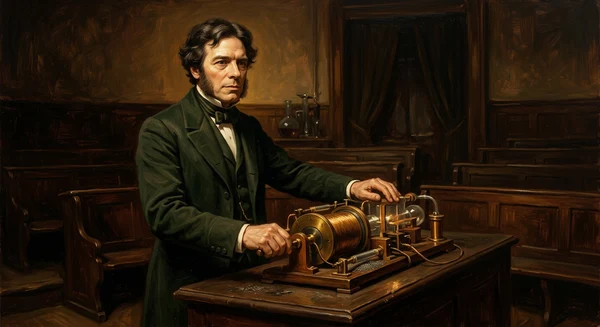
Michael Faraday
1791–1867 · Physicist & Chemist
Discovered electromagnetic induction and built the first electric motor and generator.
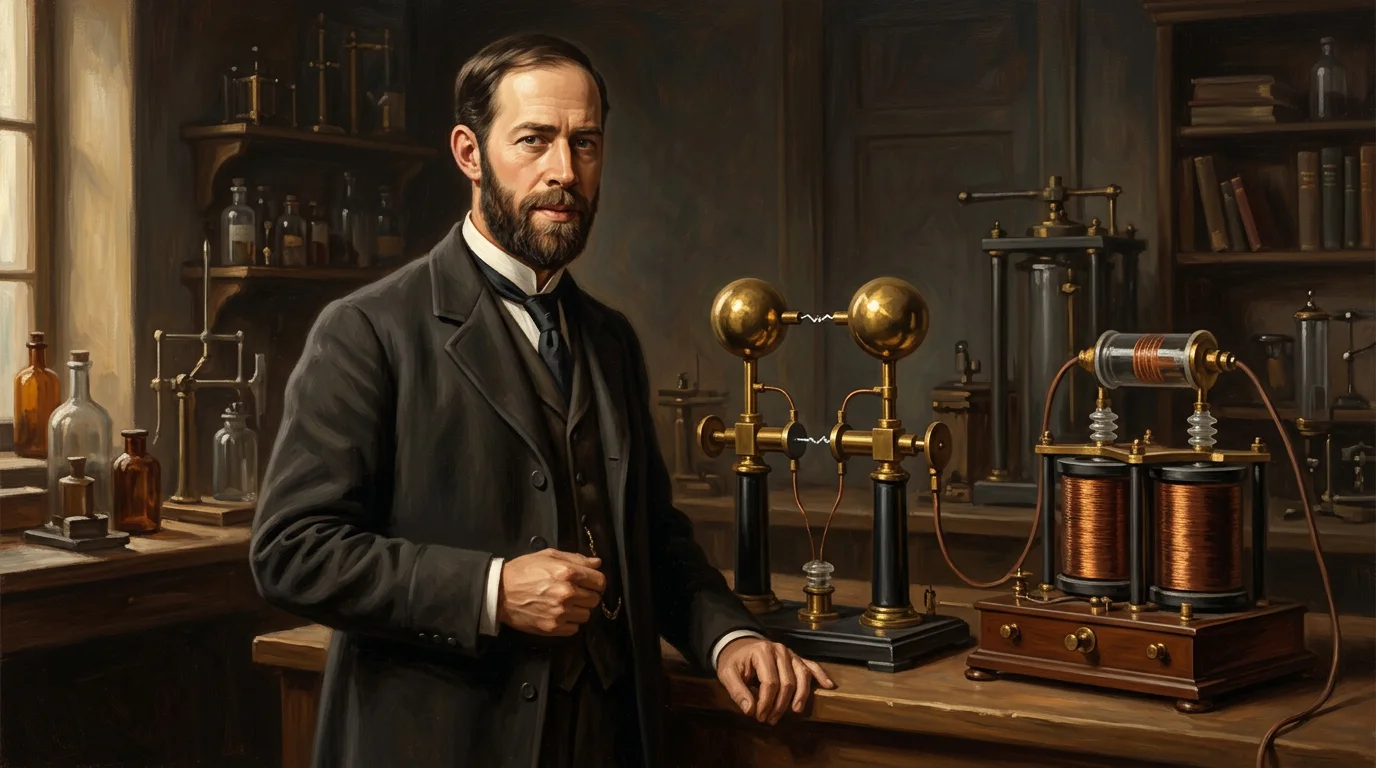
Heinrich Hertz
1857–1894 · Physicist
Demonstrated the existence of electromagnetic waves in 1887, proving James Clerk Maxwell's theory of electromagnetism and laying the foundation for radio technology. The unit hertz (Hz) is named after him.
Sources & references
Books and educational kits about André-Marie Ampère coming soon