_(2).jpg)
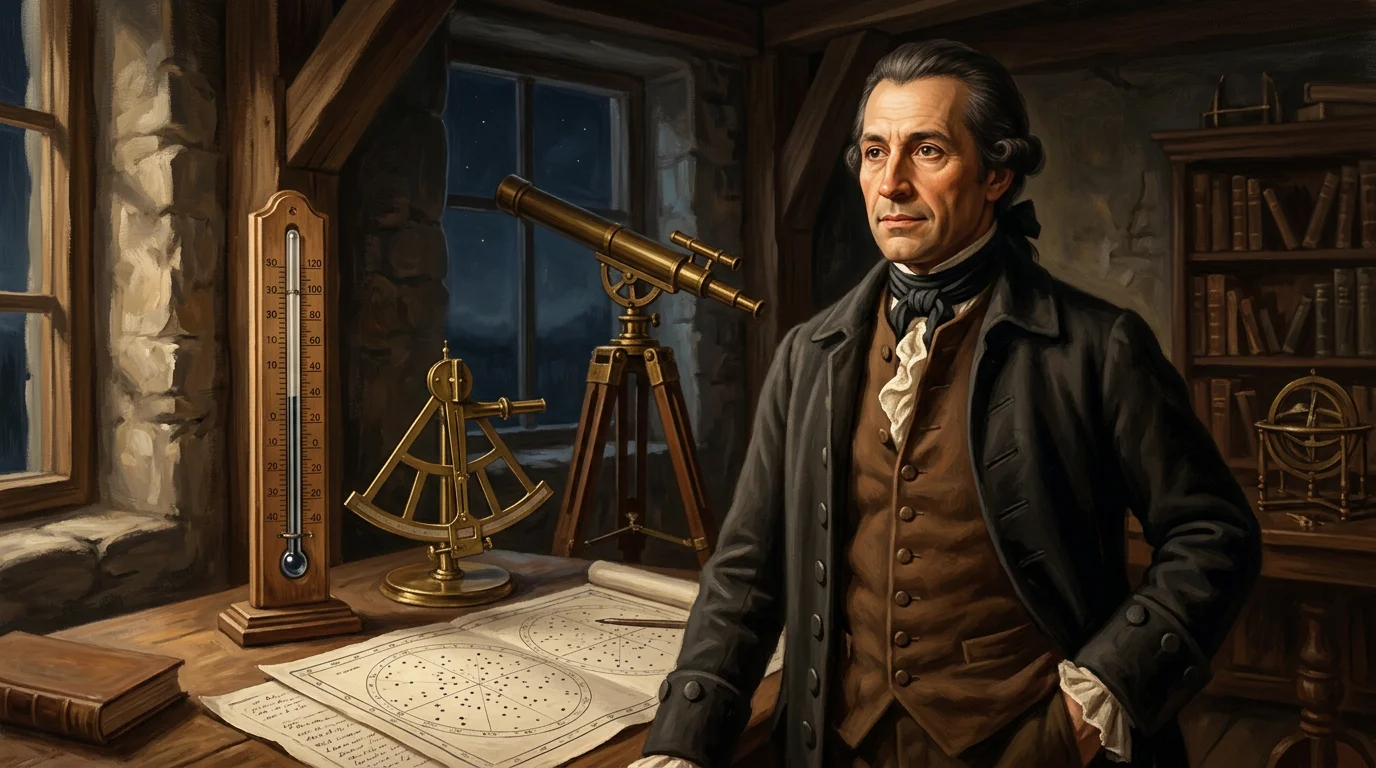
Anders Celsius
1701–1744 · Astronomer and Physicist
A Swedish astronomer who gave the world its most widely used temperature scale, while also mapping the stars and measuring the shape of the Earth.
Celsius originally set 0 as the boiling point of water and 100 as the freezing point — the scale was reversed after his death by Carl Linnaeus.
Why is this scientist famous?
Proposed the centigrade temperature scale in 1742, later renamed Celsius in his honour.
Anders's story
Early Life
Anders Celsius was born in Uppsala, Sweden, into a family of scholars. His father was a professor of astronomy at Uppsala University, and both his grandfathers were professors of astronomy and mathematics. Growing up surrounded by books, instruments, and scientific conversation, young Anders showed an early talent for mathematics and the stars. He entered Uppsala University in his teens and completed his studies there, joining the long tradition of scientific excellence that ran through his family.
Astronomer of Uppsala
Celsius became a professor of astronomy at Uppsala University in 1730, a position he held for the rest of his life. He travelled extensively across Europe from 1732 to 1735, visiting observatories in Germany, Italy, and France. In Rome he befriended some of the leading astronomers of the age, and in Paris he worked alongside Pierre-Louis Maupertuis on preparations for an expedition to measure the shape of the Earth. These journeys sharpened his skills in precise observation and instrument design. In 1741 he founded the Uppsala Astronomical Observatory, the first permanent astronomical observatory in Sweden, equipping it with the best instruments he had seen abroad.
The Lapland Expedition
In 1736 Celsius joined Maupertuis on a famous expedition to Swedish Lapland, north of the Arctic Circle. Their goal was to measure a degree of latitude near the pole and compare it with a similar measurement near the equator. The results confirmed Newton's theory that the Earth is flattened at the poles rather than perfectly spherical. Celsius made painstaking measurements of the length of a meridian degree using telescopes, quadrants, and pendulum clocks, enduring harsh Arctic conditions. The expedition was a triumph for Newtonian physics and made Celsius a respected figure across European scientific circles.
The Temperature Scale
In 1742 Celsius presented a paper to the Royal Society of Sciences in Uppsala proposing a new temperature scale based on two fixed points: the freezing and boiling of water. In his original version, 0 marked boiling and 100 marked freezing — the reverse of what we use today. The scale was elegantly simple, dividing the range between the two fixed points into exactly one hundred equal divisions. After Celsius's death, the scale was reversed so that 0 represented freezing and 100 boiling, likely at the suggestion of Carl Linnaeus. This reversed version became the standard in Sweden and spread across the world.
Other Contributions
Celsius was far more than a temperature-scale inventor. He published a catalogue of the magnitudes of 300 stars, determined using his own photometric system — one of the earliest attempts to measure star brightness systematically. He made careful observations of eclipses, aurora borealis, and the motion of the planets. He also studied the gradual rising of the Scandinavian landmass, recognising that sea levels appeared to be falling relative to the coast — an early observation of what geologists now call post-glacial rebound. His scientific curiosity ranged from the heavens to the Earth itself.
Legacy
Celsius died of tuberculosis in 1744 at the age of just 42, cutting short a career that had already transformed both astronomy and thermometry. The centigrade scale he created became the world's most widely used temperature measurement, adopted by nearly every country except the United States. In 1948 the International Committee for Weights and Measures officially renamed it the Celsius scale in his honour. The name Celsius is now recognised in every language on Earth — a rare legacy for a scientist who never lived to see his scale reversed or universally adopted.
What did they discover?
The Celsius Temperature Scale
Proposed in 1742 a temperature scale with 100 equal divisions between the freezing and boiling points of water. Originally set 0 as boiling and 100 as freezing; the scale was reversed after his death. It became the world's most widely used temperature scale, officially named Celsius in 1948.
The Lapland Expedition
Joined Maupertuis's 1736 expedition to measure a degree of latitude near the Arctic Circle. The results confirmed Newton's prediction that the Earth is flattened at the poles, settling a long-standing debate about the planet's shape.
Uppsala Astronomical Observatory
Founded in 1741, this was Sweden's first permanent astronomical observatory. Celsius equipped it with high-quality instruments acquired during his European travels, establishing Uppsala as a centre for astronomical research.
Star Brightness Catalogue
Published a catalogue of magnitudes for 300 stars using his own photometric system, achieving a mean error of just 0.4 magnitudes — one of the earliest systematic attempts to measure and record stellar brightness.
Amazing facts
Celsius originally set 0 as the boiling point of water and 100 as the freezing point — the scale was reversed after his death, possibly by Carl Linnaeus.
He was the first person to propose a temperature scale divided into exactly 100 equal parts between two natural fixed points.
The Celsius crater on the Moon is named after him.
He published a catalogue of 300 star magnitudes using his own photometric system — one of the earliest systematic brightness measurements.
During the Lapland expedition, he and his team endured freezing Arctic conditions while making measurements that confirmed the Earth is flattened at the poles.
He noticed that the Scandinavian coastline appeared to be slowly rising — an early observation of post-glacial rebound, now a well-understood geological process.
Timeline
Born in Uppsala, Sweden
Appointed professor of astronomy at Uppsala University
Began travelling through Europe, visiting observatories in Germany, Italy, and France
Joined the Lapland expedition to measure the shape of the Earth, confirming Newton's theory of a flattened polar region
Founded the Uppsala Astronomical Observatory, Sweden's first permanent observatory
Presented his centigrade temperature scale to the Royal Society of Sciences in Uppsala
Published a catalogue of magnitudes for 300 stars
Died of tuberculosis in Uppsala, aged 42
Awards & honours
Related Super Scientists
Sources & references
Books and educational kits about Anders Celsius coming soon