_(2).jpg)
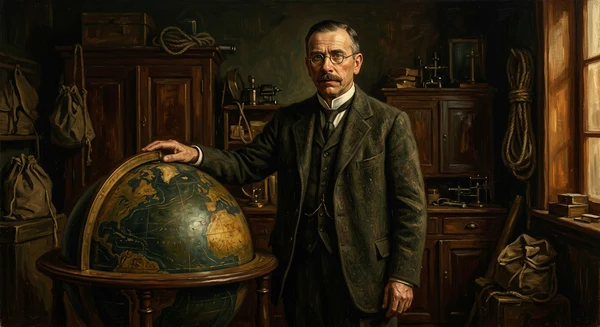
Alfred Wegener
1880–1930 · Meteorologist & Geophysicist
Alfred Wegener was a German meteorologist who proposed that continents slowly drift across the Earth's surface. His theory was ridiculed for decades, but after his death it became the foundation of plate tectonics — one of the most important ideas in geology.
“Scientists still do not appear to understand sufficiently that all earth sciences must contribute evidence toward unveiling the state of our planet in earlier times.”
Wegener noticed that the coastlines of South America and Africa fit together like puzzle pieces — and spent decades proving they were once joined, despite being laughed at by every geologist of his time.
Why is this scientist famous?
Proposed the theory of continental drift, the foundation of modern plate tectonics.
When you see an earthquake warning or a volcano on the news, you are watching the same moving plates Alfred Wegener first described. He noticed that continents looked like puzzle pieces that once fit together, an idea everyone laughed at — until it was proven true. Today, plate tectonics helps us predict earthquakes and understand our changing planet.
Alfred's story
Early Life
Born in 1880 in Berlin, Wegener studied astronomy, meteorology, and physics. He became interested in Greenland and participated in four expeditions to the ice sheet, making pioneering studies of polar meteorology and the atmosphere.
Continental Drift
In 1912, Wegener noticed that the coastlines of South America and Africa fit together remarkably well. He gathered evidence: identical fossils found on opposite sides of the Atlantic, matching rock formations, and signs of ancient tropical climates in places that are now cold. He proposed that all continents were once joined in a supercontinent called Pangaea, which had slowly drifted apart over millions of years.
Rejection
The geological community rejected Wegener's theory viciously. They mocked him as a mere meteorologist who didn't understand geology. The main objection was that no one could explain how continents could move — Wegener didn't know the mechanism, only that the evidence showed they had. He was right, but he died before he could be vindicated.
Vindication
Wegener died on his fourth Greenland expedition in 1930, age 50, probably of heart failure. In the 1960s, new evidence from ocean floor mapping and paleomagnetism confirmed that continents do move, driven by convection currents in the Earth's mantle. The theory of plate tectonics, built on Wegener's continental drift, revolutionised geology and is now accepted by every geologist on Earth.
What did they discover?
Continental Drift
Proposed that continents slowly move across the Earth's surface, once forming a supercontinent called Pangaea — the foundation of plate tectonics.
Pangaea
Named and described the ancient supercontinent Pangaea, showing how it had split apart to form the continents we know today.
Polar Meteorology
Made pioneering contributions to the study of Arctic climate and meteorology through four expeditions to Greenland.
Amazing facts
He first noticed that South America and Africa fit together like puzzle pieces on a world map.
He was a meteorologist, not a geologist — and geologists mocked him for "trespassing" in their field.
His theory of continental drift was rejected for over 40 years before being proven right.
He died on his 50th birthday during his fourth expedition to the Greenland ice sheet.
He found identical fossils in South America and Africa, proving the continents were once joined.
He also held the world record for the longest continuous hot-air balloon flight — 52 hours — in 1906.
Timeline
Born in Berlin, Germany on November 1
Earned his PhD in astronomy from the University of Berlin
Set a world record for longest hot-air balloon flight: 52 hours
Participated in his first Greenland expedition
First presented his theory of continental drift at a geological meeting
Published "The Origin of Continents and Oceans," detailing his theory of Pangaea
Published a revised and expanded edition of his continental drift theory
Died on his fourth Greenland expedition on November 2, his 50th birthday
Plate tectonics confirmed Wegener's theory, 30 years after his death
Awards & honours
Related Super Scientists

Mary Anning
1799–1847 · Paleontologist
Discovered the first complete Ichthyosaurus skeleton and became the greatest fossil hunter in history.
Charles Darwin
1809–1882 · Naturalist & Biologist
Proposing the theory of evolution by natural selection.
Rachel Carson
1907–1964 · Marine Biologist & Conservationist
Wrote Silent Spring, launching the global environmental movement.

Sources & references
Books and educational kits about Alfred Wegener coming soon