_(2).jpg)
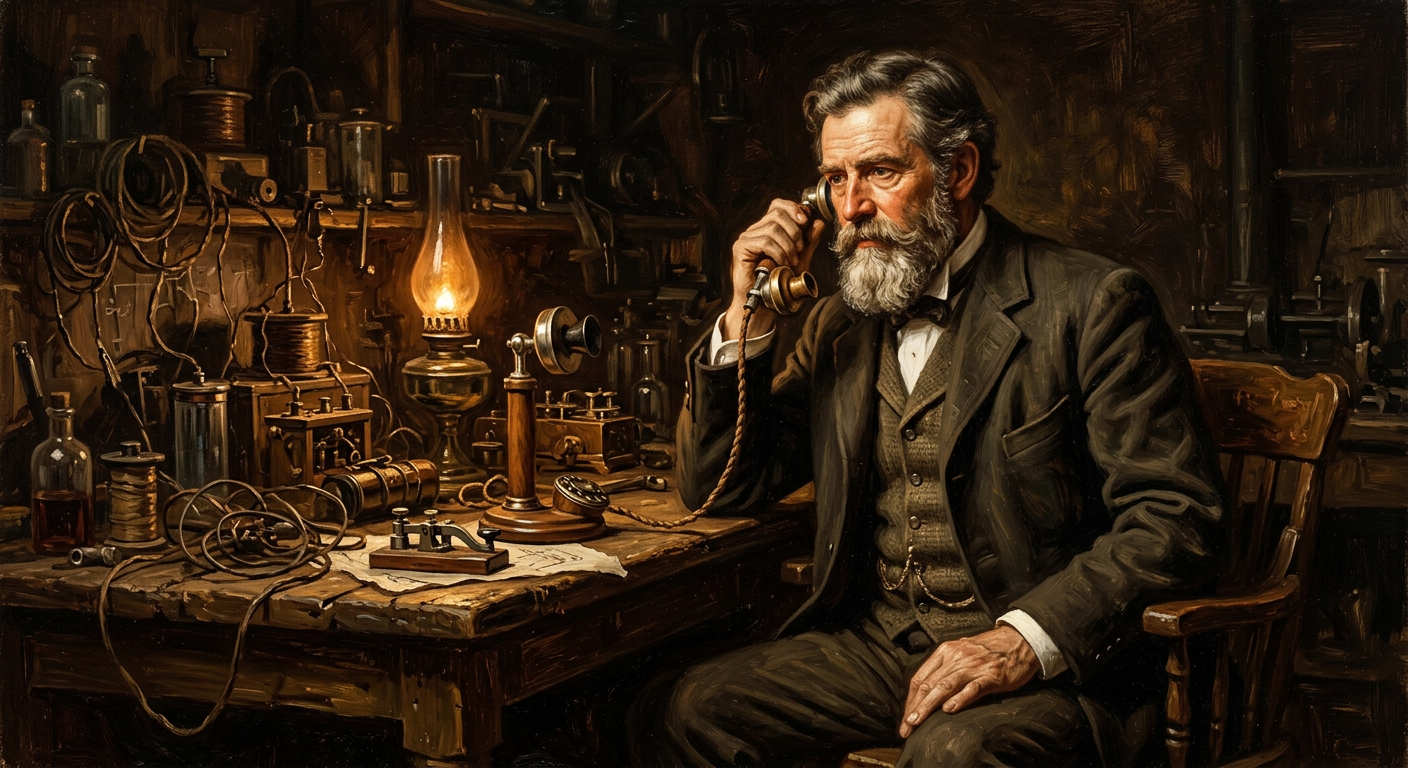
Alexander Graham Bell
1847–1922 · Inventor & Scientist
Alexander Graham Bell was a Scottish-born inventor and teacher of the deaf whose desire to help his students speak led him to the telephone — one of the most transformative inventions in history. He spent his life exploring sound, communication, and flight.
“When one door closes, another opens; but we often look so long and so regretfully upon the closed door that we do not see the one which has opened for us.”
He invented a device that could detect bullets inside the human body using a metal detector, after President James Garfield was shot in 1881 — though the president’s steel-bed springs interfered with the device and may have contributed to his death.
Why is this scientist famous?
Inventing the telephone and founding the company that became AT&T.
Every phone call, video chat, and text message traces back to Alexander Graham Bell's desire to send the human voice over a wire. The phone in your pocket is the great-great-grandchild of his invention. He showed that sound could travel across distances, an idea that eventually connected the whole planet.
Alexander's story
A Family of Voices
Alexander Graham Bell was born in 1847 in Edinburgh, Scotland, into a family obsessed with speech. His father and grandfather were both elocution teachers, and his mother, Eliza, was deaf — so young Alexander learned to press his lips against her forehead and speak in low, clear tones so she could feel the vibrations. From an early age, he and his brothers put on elaborate ‘voice shows’ for visitors, mimicking animal sounds and foreign accents. His father developed ‘Visible Speech,’ a system of symbols representing the position of the vocal organs, designed to teach deaf people to speak. This work — the mechanics of how the human voice produces sound — would shape Alexander’s entire life.
Teaching the Deaf in America
After both of his brothers died of tuberculosis, Bell’s parents emigrated to Canada in 1870, hoping the cleaner air would protect their surviving son. Bell soon moved to Boston, where he became a teacher of the deaf, following in his father’s footsteps. He was a gifted and devoted teacher — among his students was a young Helen Keller, who later called him ‘the door through which I entered life.’ He taught at the Boston School for Deaf Mutes and Boston University, and gave private lessons to deaf children of wealthy families. His most famous student was Mabel Hubbard, a deaf young woman whose father, Gardiner Greene Hubbard, would become his key financial backer — and Bell married her in 1877.
The Race for the Telephone
While teaching, Bell became fascinated by the idea of transmitting speech electrically — a ‘harmonic telegraph’ that could send multiple messages over a single wire. He lacked formal scientific training, so he hired an electrical mechanic named Thomas Watson to build his devices. On 10 March 1876, Bell spoke the first words ever transmitted by telephone: ‘Mr Watson, come here, I want to see you.’ The race to patent the telephone was extraordinarily tight — Bell filed his patent on 14 February 1876, just hours before a rival inventor, Elisha Gray, filed a similar ‘caveat.’ The patent battle that followed was one of the longest and most bitter in American legal history, but Bell’s claim held.
Building a New Industry
Bell and his backers formed the Bell Telephone Company in 1877, which eventually grew into the American Telephone and Telegraph Company (AT&T) — for decades the largest corporation in the world. But Bell himself had little interest in business. He preferred his laboratory, where he continued experimenting with sound, light, and flight. He invented the photophone, a device that transmitted sound on a beam of light — a forerunner of fibre-optic communication. He built massive kites and tetrahedral structures in pursuit of powered flight, and worked with Glenn Curtiss on the AEA (Aerial Experiment Association), which produced one of the first successful powered aircraft in Canada in 1909.
Legacy
Bell became a naturalised American citizen in 1882 and spent his summers at Beinn Bhreagh, his estate in Nova Scotia, where he continued his experiments until his death. He refused to have a telephone in his study, considering it an intrusion on his work. He died in 1922 at age 75, and at his funeral, every telephone in North America fell silent for one minute in tribute. His invention shrank the world — making instant communication across cities, countries, and eventually oceans possible. But he always said his real life’s work was teaching the deaf to speak, not the telephone.
What did they discover?
The Telephone
In 1876, Bell transmitted the first human speech by wire: ‘Mr Watson, come here, I want to see you.’ The patent he filed that day became one of the most valuable and contested patents in history.
The Photophone
A device that transmitted sound on a beam of light — wireless and decades ahead of its time. Bell considered it his greatest invention, calling it ‘the greatest invention I have ever made, greater than the telephone.’
The Metal Detector
After President Garfield was shot in 1881, Bell rushed to build a device to locate the bullet. It worked in tests but failed on the president, possibly because of the metal bed springs — a heartbreaking near-miss.
Tetrahedral Kites and Flight
Bell designed giant kites based on tetrahedral cells, believing this structure was the key to powered flight. His Aerial Experiment Association built the Silver Dart, which made the first powered flight in Canada in 1909.
Amazing facts
His mother and his wife were both deaf — and he always said his true life’s work was teaching the deaf to speak, not inventing the telephone.
He taught a young Helen Keller, who later dedicated her autobiography to him and called him ‘the door through which I entered life.’
He refused to have a telephone in his study, considering it a nuisance and an intrusion on his work.
On the day of his funeral, all telephone service in the United States and Canada was suspended for one minute in tribute.
He considered the photophone — which transmitted sound on a beam of light — his greatest invention, not the telephone.
He became a naturalised American citizen in 1882 but spent every summer at his estate in Nova Scotia, where he built laboratories and giant kites.
Timeline
Born in Edinburgh, Scotland
Emigrated with his family to Canada after his brothers died of tuberculosis
Moved to Boston to teach at the Boston School for Deaf Mutes
Spoke the first words transmitted by telephone and filed the telephone patent
Founded the Bell Telephone Company and married Mabel Hubbard
Invented the photophone, transmitting sound on a beam of light
Built a metal detector to try to locate the bullet in President Garfield
The AEA’s Silver Dart made the first powered flight in Canada
Died at Beinn Bhreagh, Nova Scotia, age 75
Awards & honours
Related Super Scientists
Thomas Edison
1847–1931 · Inventor & Businessman
Invented the practical incandescent light bulb, phonograph, and motion picture camera.
Nikola Tesla
1856–1943 · Inventor & Engineer
Pioneering alternating current (AC) electricity and numerous electrical inventions.
Hedy Lamarr
1914–2000 · Inventor and engineer
Co-inventing frequency-hopping spread spectrum technology, a foundation of modern wireless communication.
Sources & references
Books and educational kits about Alexander Graham Bell coming soon