_(2).jpg)
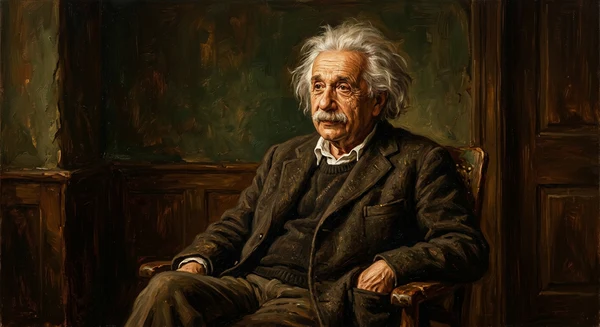
Albert Einstein
1879–1955 · Theoretical Physicist
The most famous scientist of the 20th century, Einstein reshaped our understanding of space, time, and energy with his theories of relativity.
“Imagination is more important than knowledge. Knowledge is limited; imagination encircles the world.”
Einstein failed the entrance exam to the Swiss Federal Polytechnic School at age 16 — but not in maths. He aced the maths section but fell short in non-science subjects.
Why is this scientist famous?
Developing the theory of relativity and the equation E=mc².
Einstein's ideas touch your life every day. The GPS on your phone works by timing signals from satellites, and those clocks tick slightly differently because of his theory of relativity. Without correcting for Einstein's physics, GPS directions would drift by kilometres. His curiosity about how the universe works inspires scientists — and curious kids — everywhere.
Albert's story
Early Life
Born in Ulm, Germany, Einstein was a slow talker as a child and deeply curious about how things worked. A compass given to him at age five sparked a lifelong fascination with invisible forces. He struggled with the rigid rote-learning style of German schools but excelled in mathematics and physics, teaching himself calculus by age 15.
The Miracle Year
In 1905, while working as a third-class patent clerk in Bern, Switzerland, Einstein published four extraordinary papers in a single year. These included his explanation of the photoelectric effect (which later won him the Nobel Prize), proof that atoms exist through Brownian motion, the special theory of relativity, and the famous equation E=mc². Any one of these papers would have been a career-defining achievement; together, they reshaped physics.
General Relativity
In 1915, after a decade of intense work, Einstein published his general theory of relativity, describing gravity not as a force but as the curvature of spacetime by mass and energy. Its prediction that starlight would bend around the Sun was confirmed during a 1919 solar eclipse, making Einstein world-famous overnight. The London Times headline read: 'Revolution in Science — New Theory of the Universe — Newtonian Ideas Overthrown.'
Quantum Debates
Einstein's own work on the photoelectric effect helped found quantum theory, yet he spent decades challenging its philosophical implications. He famously clashed with Niels Bohr over quantum uncertainty, declaring 'God does not play dice with the universe.' Though he turned out to be wrong about quantum randomness, his probing questions led to the discovery of quantum entanglement — what he called 'spooky action at a distance.'
Fleeing Nazi Germany
When Hitler came to power in 1933, Einstein was visiting the United States and never returned to Germany. He settled at Princeton's Institute for Advanced Study, where he worked for the rest of his life. In 1939 he signed a letter to President Roosevelt warning that Nazi Germany might develop an atomic bomb, which helped launch the Manhattan Project — a decision he later deeply regretted, calling it the one mistake of his life.
Legacy
Einstein became a global icon, not just for his physics but for his humanitarianism. He campaigned for civil rights in America, corresponded with W.E.B. Du Bois, and was offered the presidency of Israel in 1952, which he politely declined. He spent his final decades searching for a unified field theory that would unite gravity and electromagnetism — a quest that remains unfinished to this day. He died in Princeton in 1955, having published over 300 scientific papers and 150 non-scientific works.
What did they discover?
Special Relativity
Showed that space and time are relative, not absolute, and that the speed of light is constant for all observers regardless of their motion. This overturned two centuries of Newtonian physics.
E = mc²
Proved that mass and energy are interchangeable — a tiny amount of mass contains enormous energy. This equation underlies nuclear power and is perhaps the most famous equation in science.
General Relativity
Described gravity as the bending of spacetime by mass and energy, replacing Newton's theory of gravitation. It predicted black holes, gravitational waves (confirmed in 2015), and the expanding universe.
Photoelectric Effect
Showed that light delivers energy in discrete packets (quanta), laying the foundation for quantum theory and winning the 1921 Nobel Prize in Physics.
Brownian Motion
His analysis of the jittering motion of particles in a liquid provided the first direct evidence that atoms and molecules are real, ending a century of scientific debate.
Bose-Einstein Condensate
With Satyendra Nath Bose, predicted a new state of matter near absolute zero where atoms behave as a single quantum entity — created in a laboratory for the first time in 1995.
Amazing facts
He won the 1921 Nobel Prize not for relativity but for the photoelectric effect.
When he published his 1905 papers, he was a third-class examiner at the Swiss patent office.
He was offered the presidency of Israel in 1952 but politely declined.
His brain was preserved after his death and studied for decades; it showed unusual neuron density in areas linked to spatial reasoning.
He loved sailing but never learned to swim.
He published over 300 scientific papers and 150 non-scientific works in his lifetime.
He failed the entrance exam to the Zurich Polytechnic on his first attempt — at age 16.
He famously declared 'God does not play dice with the universe' in a debate with Niels Bohr over quantum mechanics.
His 1919 solar eclipse confirmation made him an overnight celebrity — newspaper sellers shouted his name in the streets.
His last words were spoken in German to a nurse who did not speak German, so they were lost forever.
Timeline
Born in Ulm, Germany
Failed the entrance exam to the Zurich Polytechnic at age 16
Became a Swiss citizen and took a temporary teaching post
Began working as a patent clerk at the Bern Patent Office
Published four groundbreaking 'miracle year' papers
Became a professor at the University of Zurich
Completed the general theory of relativity
Solar eclipse confirmed his prediction of light bending around the Sun
Won the Nobel Prize in Physics for the photoelectric effect
Fled Nazi Germany and joined Princeton's Institute for Advanced Study
Signed the letter to President Roosevelt urging atomic research
Declined the presidency of Israel
Died in Princeton, New Jersey, age 76
Awards & honours
Related Super Scientists
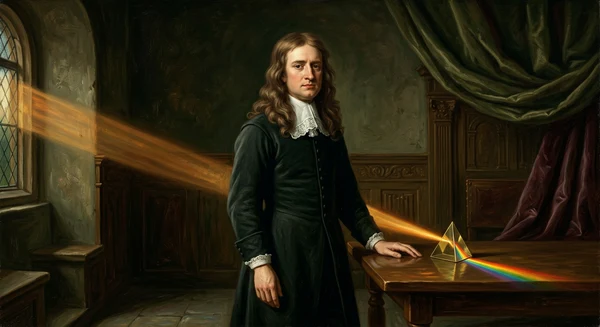
Isaac Newton
1643–1727 · Physicist & Mathematician
Formulating the laws of motion and universal gravitation.
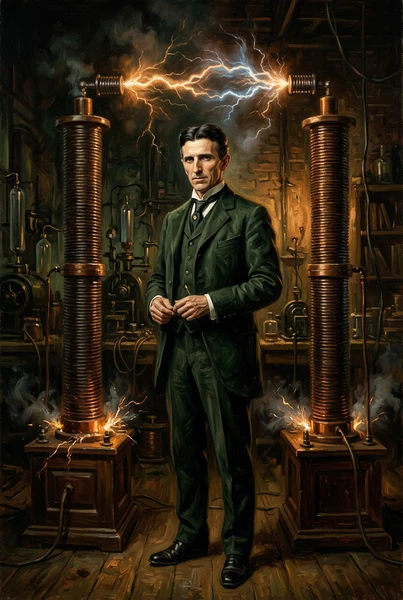
Nikola Tesla
1856–1943 · Inventor & Engineer
Pioneering alternating current (AC) electricity and numerous electrical inventions.
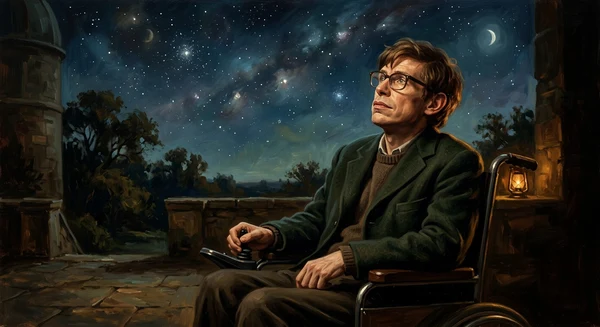
Stephen Hawking
1942–2018 · Theoretical Physicist & Cosmologist
Discovering that black holes emit radiation and writing "A Brief History of Time."
Articles about this scientist
Sources & references
Books and educational kits about Albert Einstein coming soon