_(2).jpg)
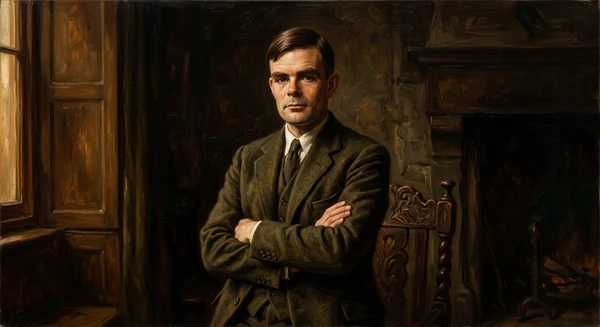
Alan Turing
1912–1954 · Mathematician & Computer Scientist
The father of computer science and artificial intelligence, Alan Turing's codebreaking shortened World War II and saved millions of lives.
“Sometimes it is the people no one imagines anything of who do the things that no one can imagine.”
Turing designed a theoretical computer in 1936 that could solve any mathematical problem — it became the blueprint for every computer on Earth.
Why is this scientist famous?
Breaking Nazi codes and founding the science of artificial intelligence.
When you ask a phone assistant a question, get a movie recommendation, or see a computer recognise your face, you are seeing the seeds Alan Turing planted. He asked "Can machines think?" — a question that launched artificial intelligence. His codebreaking work also helped prove that World War II could be won faster, saving millions of lives.
Alan's story
Early Life
Born in London, Turing showed extraordinary mathematical talent from a young age. He was a loner at school, but found a kindred spirit in Christopher Morcom, a fellow student who shared his love of science. Morcom's sudden death from tuberculosis when they were both 18 devastated Turing and deepened his fascination with whether the mind could exist beyond the body — a question that would drive his later work on artificial intelligence.
The Turing Machine
At Cambridge in 1936, Turing imagined a simple theoretical machine — the 'Turing machine' — that could compute anything that is computable. He used it to prove that some mathematical problems cannot be solved by any algorithm, solving Hilbert's Entscheidungsproblem. This concept became the mathematical foundation of all computer science. The same year, he travelled to Princeton to study with Alonzo Church, who had arrived at equivalent results by a different route.
Breaking Enigma
During World War II, Turing worked at Bletchley Park, Britain's secret codebreaking centre. He designed the 'Bombe' — an electromechanical machine that could rapidly test settings for the German Enigma cipher. The intelligence from broken Enigma messages (called 'Ultra') is estimated to have shortened the war by two to four years and saved millions of lives. At its peak, Turing's Bombe was cracking over 80,000 Enigma messages per month. He also worked on the Lorenz cipher used by German high command.
After the War
After 1945, Turing designed early stored-program computers at the National Physical Laboratory and the University of Manchester. He wrote the first computer chess program, which was so advanced it could not run on any existing machine. He also pioneered the field of mathematical biology, using equations to explain how tigers get their stripes and how sunflowers grow their spirals — a field now called morphogenesis.
The Turing Test
In his seminal 1950 paper 'Computing Machinery and Intelligence,' Turing asked 'Can machines think?' Rather than defining thought, he proposed a practical test: if a human cannot distinguish between a machine and a human in conversation, the machine can be considered intelligent. This 'Turing Test' became the foundational concept of artificial intelligence and remains influential today.
Tragedy and Pardon
In 1952, Turing was prosecuted for homosexuality — then a crime in Britain — and forced to accept chemical castration to avoid prison. He died on 7 June 1954 from cyanide poisoning. The official verdict was suicide, though some historians dispute this. It took over 60 years for his contributions to be fully recognised: he received a royal pardon in 2013, appeared on the £50 note in 2021, and his portrait now hangs at Bletchley Park. The 'Turing Award' — computing's equivalent of the Nobel Prize — is named in his honour.
What did they discover?
The Turing Machine
A theoretical model of computation that proved which problems are solvable by machines — the mathematical foundation of all computer science.
The Bombe
An electromechanical machine that broke German Enigma codes, giving the Allies critical intelligence throughout WWII and shortening the war by an estimated two to four years.
The Turing Test
A method for determining whether a machine can exhibit intelligent behaviour indistinguishable from a human's — the foundational concept of artificial intelligence.
Morphogenesis
His final work used mathematics to explain how biological patterns like tiger stripes and sunflower spirals form from simple chemical gradients — founding the field of mathematical biology.
Stored-Program Computers
Designed some of the first computers that stored instructions in memory, including the ACE at the NPL and contributions to the Manchester computers.
Amazing facts
His codebreaking at Bletchley Park is estimated to have shortened World War II by two to four years.
He was an Olympic-level marathon runner, regularly running 40 miles to meetings.
He was prosecuted for homosexuality in 1952 and forced to undergo chemical castration.
He appears on the current UK £50 note.
Queen Elizabeth II granted him a posthumous royal pardon in 2013.
The 'Turing Award' — computing's equivalent of the Nobel Prize — is named after him.
He wrote the first computer chess program in 1950, before any computer could run it.
He cycled around Bletchley Park wearing a gas mask to control his hay fever.
His work was so secret that even his family did not know about his codebreaking until decades after his death.
He buried his savings in silver ingots in the countryside during the war, then forgot exactly where he buried them.
Timeline
Born in London, England
Entered King's College, Cambridge to study mathematics
Published the concept of the Turing machine at Cambridge
Returned to Cambridge from Princeton
Joined Bletchley Park to break German codes
Designed the Bombe to crack Enigma
Joined the National Physical Laboratory to design the ACE computer
Moved to the University of Manchester
Published 'Computing Machinery and Intelligence,' introducing the Turing Test
Convicted of gross indecency and sentenced to chemical castration
Died from cyanide poisoning, age 41
The British government issued an official public apology
Received a posthumous royal pardon from Queen Elizabeth II
Awards & honours
Related Super Scientists
Articles about this scientist
Sources & references
Books and educational kits about Alan Turing coming soon