_(2).jpg)
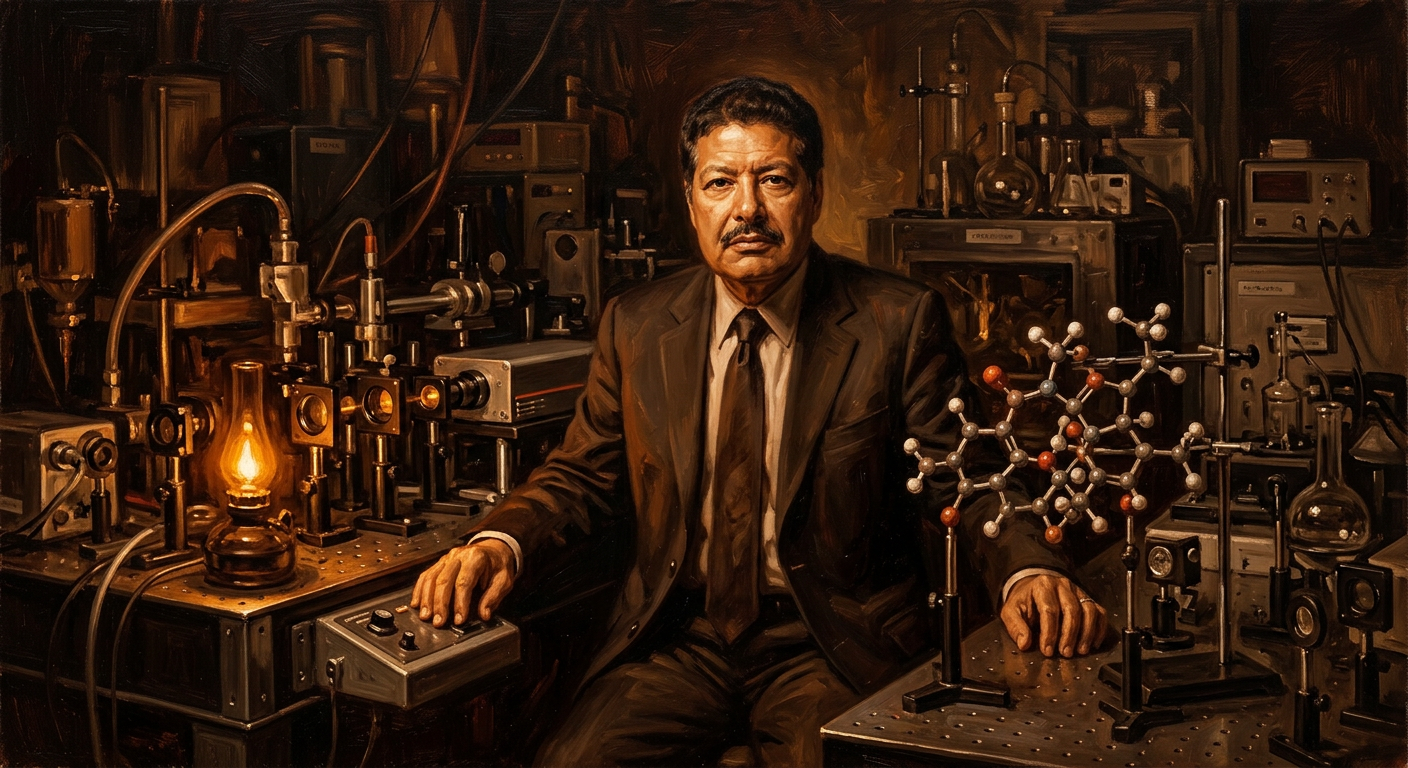
Ahmed Zewail
1946–2016 · Chemist
Ahmed Zewail was a chemist who used ultra-fast lasers to watch chemical bonds form and break in real time, creating an entirely new field called femtochemistry. He was the first Egyptian and first Arab to win a Nobel Prize in science.
“Although there exist in the world today some microbes of the soul, such as discrimination and aggression, science was and still is the core of progress for humanity and the continuity of civilization.”
He was the first Egyptian and the first Arab to win a Nobel Prize in a scientific field, and in 2009 President Obama appointed him the first U.S. Science Envoy to the Middle East.
Why is this scientist famous?
Pioneering femtochemistry, the use of lasers to observe chemical reactions on the timescale of femtoseconds, earning the Nobel Prize in Chemistry in 1999.
Ahmed's story
Early Life in Egypt
Ahmed Hassan Zewail was born on February 26, 1946, in Damanhur, a city in the Nile Delta of Egypt. His father was a government official who valued education deeply, and his mother encouraged his curiosity from a young age. As a child, Ahmed was fascinated by how things worked — he took apart radios and clocks, read science books voraciously, and set up a small chemistry lab in his home using chemicals he bought from a local pharmacist. He studied at the University of Alexandria, earning his bachelor’s and master’s degrees in chemistry. He dreamed of studying abroad, but he came from a modest background in a developing country, and the path to international science was not obvious. He worked hard, taught himself English, and eventually won a scholarship to the United States.
The Journey to Caltech
In 1976, Zewail left Egypt for the University of Pennsylvania, where he earned his PhD in chemical physics. He then spent two years as a postdoctoral researcher at the University of California, Berkeley, before joining the faculty at the California Institute of Technology (Caltech) in 1982. Caltech was one of the world’s great centres of physics and chemistry, and Zewail thrived there. He was drawn to a problem that had puzzled chemists for decades: chemical reactions happen incredibly fast, in times measured in femtoseconds — million-billionths of a second — and no one had ever been able to watch them as they happened. Chemists could see what went into a reaction and what came out, but the actual moment of transformation, when old bonds broke and new ones formed, was a blur too fast to capture.
Inventing Femtochemistry
Zewail’s breakthrough was to use incredibly short pulses of laser light — each lasting only a few femtoseconds — to take snapshots of molecules as they reacted. By firing a first pulse to start a reaction and then a series of timed pulses to photograph the molecules at different moments, he created what amounted to a slow-motion movie of a chemical reaction. For the first time in history, scientists could watch bonds breaking and forming in real time, see the temporary intermediate states that existed for only a few femtoseconds, and understand exactly how reactions proceed. He called this new field femtochemistry, and it transformed chemistry from a science of before-and-after snapshots into one of real-time observation. His work had implications far beyond chemistry, influencing physics, biology, and materials science.
Nobel Prize and Global Influence
In 1999, Zewail was awarded the Nobel Prize in Chemistry, the sole recipient, for his studies of the transition states of chemical reactions using femtosecond spectroscopy. He was the first Egyptian and the first Arab to win a Nobel Prize in a scientific field, and he became a national hero in Egypt, where streets and schools were named after him. But he was not content to rest on his achievements. He founded the Zewail City of Science and Technology, a research university in Cairo, to give young Egyptian scientists the opportunities he had to travel abroad to find. In 2009, President Barack Obama appointed him the first U.S. Science Envoy to the Middle East, sending him to build scientific partnerships between America and the Arab world. He believed that science was a universal language that could bridge cultures and build peace.
Legacy
Zewail died on August 2, 2016, in Pasadena, California, at the age of 70. He left behind a transformed field of chemistry, a research institute in Egypt, and a legacy as a scientist who bridged cultures and believed in the power of education. He published over 600 scientific papers, mentored hundreds of students, and received dozens of honorary degrees and international prizes. He was a member of the National Academy of Sciences, the American Academy of Arts and Sciences, and numerous scientific academies around the world. His story — a boy from the Nile Delta who took apart radios and built a chemistry lab in his house, who traveled across the world to watch molecules react in real time — is a testament to what curiosity and determination can achieve, regardless of where you start.
What did they discover?
Femtochemistry
Zewail used ultra-short laser pulses to observe chemical reactions in real time, capturing the breaking and forming of molecular bonds on the femtosecond timescale. This created an entirely new field of chemistry, transforming it from before-and-after snapshots to real-time observation.
Transition State Spectroscopy
He developed techniques to observe transition states — the fleeting intermediate configurations that molecules pass through during a reaction, which had never been directly observed before his work.
4D Electron Microscopy
Later in his career, Zewail extended his time-resolved techniques to electron microscopy, creating four-dimensional imaging that could capture both the spatial structure and the time evolution of nanoscale processes.
Amazing facts
He was the first Egyptian and the first Arab to win a Nobel Prize in a scientific field.
He built a homemade chemistry lab as a child using chemicals bought from a local pharmacist in Egypt.
He earned his bachelor’s and master’s degrees at the University of Alexandria before winning a scholarship to the United States.
He created what amounted to a slow-motion movie of a chemical reaction, watching bonds break and form in real time.
He founded the Zewail City of Science and Technology, a research university in Cairo, to give Egyptian scientists opportunities at home.
In 2009, President Obama appointed him the first U.S. Science Envoy to the Middle East.
He published over 600 scientific papers during his career.
He was a member of the National Academy of Sciences and numerous scientific academies around the world.
A femtosecond is one million-billionth of a second — the timescale on which chemical reactions actually happen.
He believed science was a universal language that could bridge cultures and build peace.
Timeline
Born in Damanhur, Egypt, in the Nile Delta
Earned a bachelor’s degree in chemistry from the University of Alexandria
Earned a master’s degree from the University of Alexandria
Earned his PhD in chemical physics from the University of Pennsylvania
Joined the faculty at the California Institute of Technology (Caltech)
Made his first breakthrough in femtochemistry, using lasers to watch molecules react in real time
Awarded the Nobel Prize in Chemistry for his work on femtochemistry
Founded the Zewail City of Science and Technology research university in Cairo
Appointed by President Obama as the first U.S. Science Envoy to the Middle East
Died in Pasadena, California, on August 2, age 70
Awards & honours
Related Super Scientists
Antoine Lavoisier
1743–1794 · Chemist
The father of modern chemistry who overturned the phlogiston theory and established the law of conservation of mass.
Max Planck
1858–1947 · Theoretical Physicist
Discovering that energy is emitted in discrete packets called quanta, launching the field of quantum physics.
Niels Bohr
1885–1962 · Physicist
Developed the Bohr model of the atom and made foundational contributions to quantum mechanics.
Sources & references
Books and educational kits about Ahmed Zewail coming soon